IDÉE CADEAUX

Vous êtes déjà en quête de cadeaux de fin d’années…
Vous voulez en savoir plus sur les stars de la discipline…
Vous voulez faire plaisir à un parent ou à un ami passionné…
Vous voulez faire un cadeau d’anniversaire ou de départ à la retraite…
Ces livres sont peut-être une réponse à vos attentes
A commander auprès de Cyrille COSTES
– Par tél. au 06 21 06 80 65
– Par mail à cyrille.costes@petanque12.com
Boulodrome intercommunal Saint-Marc
Interpelés, les élus tapent en touche…
Le président Cabanes, reçu ce lundi par les élus de Rodez Agglo, s’est dit « déçu, frustré et découragé » au sortir de la rencontre.

Parce qu’il avait envoyé un courrier en septemre dernier aux élus de Rodez Agglo, courrier visant à les informer des conditions de gestion mises en place par l’actuelle Amicale, le président du Quatre-Saisons Pétan Club a eu droit à une rencontre. Accompagné de Frédéric Cartaillac, il a éré reçu par deux Vice-Présidents, Alain Cisternino et Michel Arnal, ainsi que par Bruno Gares. Plus d’une heure durant, ses interlocuteurs se sont refusés à intervenir dans ces guéguerres internes au monde de la pétanque et ont préféré continuer à taper en touche : « Si la gestion actuelle ne vous convient pas, il vous faut convaincre un ou deux autres clubs de vous rejoindre pour intégrer cette amicale. Et lors de la prochaine assemblée générale; être capable d’apporter une solution d’alternative supposée remplacer la gouvernance actuelle ». Ou comment dérouler le tapis rouge à un trio gourvernant (Les Costes-Rouges, La Boule d’Or et Sainte-Radegonde, NDLR) qui mise justement sur l’incapacité d’une opposition à s’entendre et à se fédérer pour continuer à régner de mains de maîtres sur la gestion de ce boulodrome. Notamment en imposant des conditions de mise à disposition de la structure pour le moins dissuasives (loyer de 350 euros la journée, obligation de fournir ses propres boissons…). Un coup de projecteur plus appofondi sur ces conditions semble être, en fait, le seul point positif de cette rencontre. Contrairement à ce qui avait été affirmé jusqu’à présent, la machine à café serait bien utilisable. Comme seraient également utilisables les deux pompes à bière à condition d’apporter… ses propres fûts. Ces deux éclairs dans la grisaille suffiront-ils à écarter l’ambiance orageuse et délétère qui règne entre les clubs de Rodez Agglo. Rien de moins sûr puisque le président André Cabanes s’est dit « déçu, frustré et découragé » au sortir de cet énième épiside d’une bataille qui n’a que trop duré. Et pour répondre à la question que tout le monde se pose, à savoir si le concours du 11-novembre organisé par le Quatre-Saisons Pétan Club aura lieu ou pas, il faudra attendre ce mercredi 28 octobre et la réunion du bureau directeur du club castonétois, pour en connaitre la décision officielle et définitive. Décision que l’on ne manquera évidemment pas de vous communiquer.
8e souvenir Matthias-Albertini
Le Lavandou, grande vitrine des incohérences de la pétanque
Les week-ends se suivent et les résultats sont toujours les mêmes. « Henri Lacroix, c’est le plus fort, un poin(g) c’est tout » : le titre dnu livre que l’on vient de lui consacrer n’a jamais paru autant d’actualité. Associé à son ami Simon Cortès et au pointer Pascal Albertini, le joueur de La Crau a encore une fois fait preuve de tout son talent et de l’étendue de ses qualités. Lui que certains s’amusent à faire pointer devant, lui que Philippe Suchaud définit comme le meilleur milieu au monde…, a cette fois gagné en tirant devant. A quelques semaines des Championnats du Monde, voir la France se priver du meilleur joueur au monde, c’est voir une pétanque hexagonale se tirer une balle dans le pied. Elles doivent bien rigoler les autres fédérations adversaires potentielles de voir la FFPJP se priverde celui que toute équipe nationale rêverait d’avoir en son sein. Ce n’est malheureusement pas la seule incohérence entrevue dans ce centre-ville du Lavandou. Il y a quelques décennies encore, les écoles de pétanque n’existaient pas. Les coaches sécetionneurs non plus. On apprenait à mener le jeu en observant les meilleurs, ceux qui gagnaient. Où était alors un certain Laurent N’Guyen à ce moment là ? De la trempe des Diego Rizzi et autre Dylan Rocher, cet N’Guyen a chpé le virus du tir au but. Auteur d’une chique et d’un trou dès le première mène de la finale, il a envoyé son milieu Olivier au tir au ut. Un manqué double plus tard, un carreau ciseau de Lacroix plus tard, c’était une première mène de 6 points en n’ayant vraiment joué de 2 boules (les 4 autres ont été jetées) qui ont inauguré cette finale. Plutôt ue de pondre des sempiternels nouveaux règlements, plutôt que d’interdire le port du « jean » et de contraindre de porter des tenues homogènes, plutôt que de lancer de toujours nouvelles épreuves qui encomrent les calendriers et font débuter les championnats… fin février, plutôt que de se priver de ses meilleus joueur (Rocher, Lacroix, Suchaud, Doerr…) en sélection, la pétanque et ceux et celles quii la dirigent feraient mieiux de se regarderdans une glace. Ou alors ils prendraient conscience de leurs incohérences et de leurs insuffisances ou alors ils feraient bien de s’en aller. Et vite avant qu’il ne soit trop tard. Tiens, tiens, ce cas de figure nous rappelle un autre cas de figure. N’est-ce pas Monsieur le Président Macron ? Décidément, c’est dur pour ne pas dire impossile de quitter le pouvoir quand il vous est tombé dessus. Même quand vous n’avez pas l’étoffe pour l’assurer.
Carnet Noir
L’ancien président Jacques Edouard s’en est allé
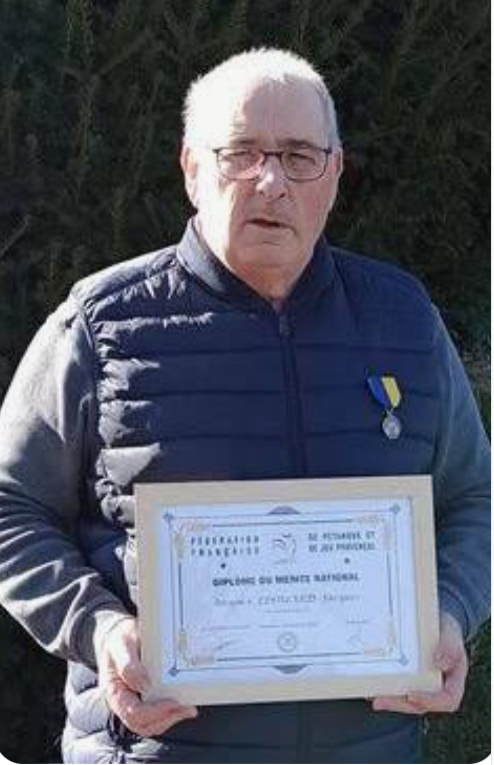
C’est incontestalement une figure emblématique de la pétanque aveyronnaise qui vient de partir. Originaire de Villeranche-de-Rouergue où il tenait un commerce de charcuterie, Jacques Edouard n’avait pas tardé à former un sacré binôme avec un certain José Raynal à la tête de la Pétanque Villeranchoise. Après en avoir pris la présidence, il avait été élu au Comité départemental, instance dont il avait assuré la présidence. Ayant ensuite muté à Drulhe, il avait logiquement pris la présidence de la Fanny locale. Bénévole au long cours, Jacques Edouard était un garçon qui n’aimait pas les conflits et qui mettait tout en oeuvre pour satisfaire le plus grand nomre de ses interlocuteurs. Serviale à souhait, on savaot que l’on pouvait compter sur lui pour nous donner des informations et nous transmettre des résulats que certains autres prenaient un malin plaisir à nous priver. « Pétanque 12 » présente ses plus sincères condoléances à ses plus proches et n’oubliera jamais la grande implication de Jacques au profit de la pétanque aveyronnaise.
Disparition
Christophe « Néné » Hygonnet a perdu son papa
Il avait été fier et heureux comme un pape quand son « Néné » de fiston avait été sacré Champion d’Aveyron en triplettes il y a quelques années de ça. Nous avons appris le décès de Yvon Hygonnet, fidèle spectateur des grands rendez-vous de pétanque organisés sur le Ruthénois. A toute sa famille passionnée de pétanque, à son fils Christophe, à son frère Roland et à son neveu Jean-Paul, « Pétanque 12 » présente ses plus sincères condoléances.
Championnat Départemental des Clubs (CDC)
Les filles du Quatre-Saisons PC retrouvent le niveau régional
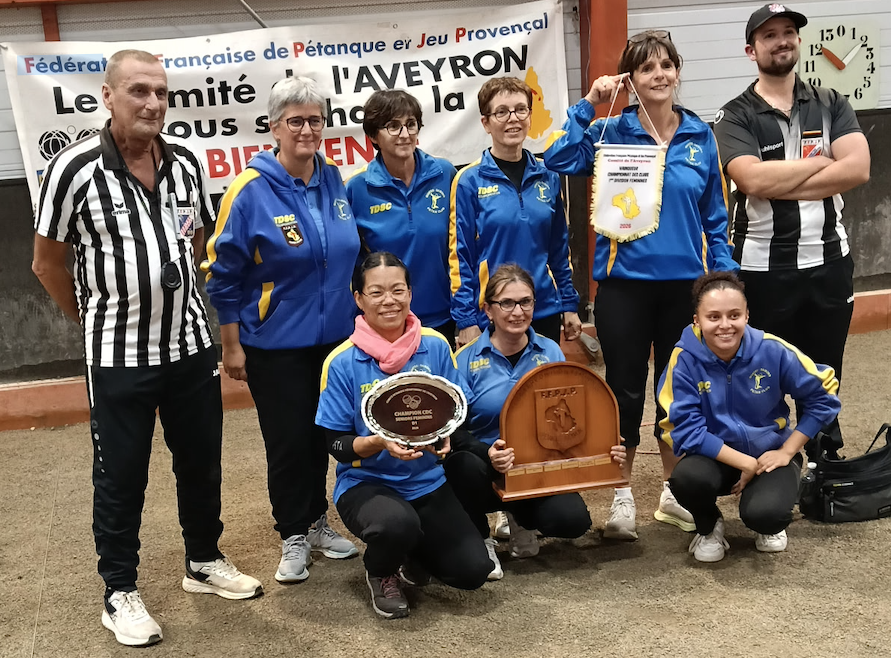
C’était l’une des interrogations de ce dimanche ? Quel club allaiy être sacré chez ces dames et demoiselles pour se voir ainsi les portes du Championnat Régional (CTRC) l’an prochain. Entre les deux Pétan Clubs, celui des Quatre-Saisons et celui de Laissac – Bertholène, le suspense a été total et la rencontre a tardé à donner le réponse attendue. A l’issue des 11 parties règlementaires, l’égalité était en effet parfaite (18 partout). La décision s’est donc faite au fameux tir de départage et, à ce petit jeu, ce sont les Castonétoises quin ont été sacrées Championnes d’Aveyron et qui retrouveront l’an prochain un niveau régional qui était le leur il n’y a pas si lontemps. Félicitations à elles mais aussi aux féminines de Laissac – Bertholène.
Challenge Paul-Granier à Creissels
49 doublettes ce samedi à la première étape
49 doublettes étaient présentes, ce samedi à 10 heures, au boulodrome Paul-Granier de Creissels, pour y disputer la 1ère étape qualificative du Challenge éponyme. Prochaines étapes : dimanche 22 novembre (8 qualifiés), samedi 9 janvier (8 qualifiés) et dimanche 31 janvier (6 qualiiés). Finale le samedi 13 février (32 doublettes).
Les qualifiés de cette 1ère étape (*)
Miléi – Miléi (Creissels), Boutet – Grau (Lozère), Nespoulous Cl. -Combes Y. (NH Aveyron), Bucciero – Aigouy (NH Aveyron), Bonneviale – Guerrero (Creissels), Da Costa – Bedos (Laissac – Bertholène), Ch. Combes – Gavalda (Creissels), Laur – Durand (NH).
(*) Merci au président Jean Treillet pour la communication de ces résultats.
Concours du 11-Novembre du Quatre-Saisons PC : quelle tendance avant une semaine décisive ?
Si concours du 11-Novembre il doit y avoir cette année au boulodrome intercommunal Saint-Marc, ce ne sera sans doute pas la version officielle initialement proposée par le Quatre-Saisons Pétan Club. Le club présidé par André Cabanes ne faisant plus partie de l’Amicale, l’utilisation du boulodrome fait l’objet de conditions. Des conditions jugées par le bureau, le président en tête, inacceptables : « Aux 350 € de location à verser à l’Amicale, il faut aussi ajouter une caution de 350 € à verser à Rodez Agglo. Nous n’avons accès ni à la machine à cafés ni à la pompe à bière. Pour le reste des boissons, il faudrait jongler en permanence avec un camion frigorifique en extérieur et deux petits frigos intérieurs. Ajoutez enfin les 1 000 € d’apport de la société, et c’est la quasi garantie de perdre de l’argent. Alors, dans ces conditions… » Dans ces conditions, rien n’est certes officiel – la réunion de décision se tiendra le mercredi 28 octobre prochain, NDLR – mais la tendance est connue. Si concours il doit y avoir ce mercredi 11 novembre, ce sera une version amicale et certainement pas officielle. Rien ne dit que les conditions, notamment financières, seraient alors les mêmes, et le concours pourrait bien perdre en attractivité. Le Quatre-Saisons Pétan Club, lui, ne perdrait alors qu’un petit billet de 100 €. 100 €, comme le montant de l’amende due par un club à son comité départemental pour non tenuue d’un concours officiel annoncé sur le calendrier.
Championnat National des Clubs (CNC) vétérans
La patience de l’ABC Draguignan enfin récompensée
Finaliste pour la 4e année consécutive, le club varois a enfin décroché le titre national.
Draguignan contre les Sables d’Olonne, c’était l’affiche de la finale du CNC vétérans ce jeudi à Montluçon. Si les Varois prenaient le meilleur départ (5 victoires en tête-à-tête), ils laissaient les joueurs de la Vienne espérer en les laissant gagner deux doublettes. Il sufisait pourtant aux Méditerranéens de remporter une seule victoire en triplettes pour être sacrés Champions de France. Une récompense méritée pour une 4e finale consécutive de CNC de club.
A l’affiche ce week-end
Samedi 24 octobre
A Réquista .- Concours départemental en triplettes mixtes doté des mises + 50%. Inscriptions : 15 €. Jet du but à 14 h 30.
A Villefranche .- Concours amical en doublettes. Inscriptions : 10 €. Jet du but à 14 h 30.
A Rodez .- Concours amical en doulettes et en « 3 parties. Jet du but à 14 h 30.
Dimanche 25 octobre
A Lacroix – Barrez .- Journée finale des CDC Open et Féminines. Jet du but pour les premières parties à 8 h 30.
Mardi 27 octobre£A Millau .- 4e et dernière tape qualificative du challenge triplettes vétérans (8 équipes à qualifier pour la finale). Inscriptions : 15 €. Jet du but à 14 h 30.
Finales des Championnats Départementaux des Clubs ce dimanche
Lacroix-Barrrez était-il le meilleur choix à faire ?
Ce dimanche, pas moins de 17 équipes représentant 14 clubs différents participeront à la journée finale de CDC Open et Féminines. Ce dimanche, des pluies certes modérées mais seulement 7 petits degrés sont annoncés en matinée en Nord-Aveyron. IL ne reste donc plus qu’une chose à espérer. Que la halle Louis-Boyer puisse accueillir l’intéralité des rencontres sous son aire couverte. Quelle que soit la réalité, une question se pose. Lacroix-Barrez, site excentré à souhait, était-il le bon choix à faire ? Cela fait maintenant des mois que l’on sait que le boulodrome intercommunal de Saint-Marc sera opérationnel. N’aurait-il pas été plus judicieux de « rapatrier » cette journée de finales en centre Aveyron ? Chacun en pensera ce qu’il veut mais la question méritait sans doute d’être posée.

Seulement 21 triplettes vétérans à Millau
Qualification des Ruthénois Reynès, Rabanel et Poplin
Les intempéries de la veille ont sans doute refroidi les ardeurs des pétanqueurs d’Occitanie qui participent traditionnellement à ce challenge vétérans proposé par le PJ Millau. Seulement 21 étaient en effet présenntes et l’on a décidé de les répartir en poues 3 et en poules de 4. Certaines équipes se sont ainsi qualifiées en sortant juste de poues. Ce ne fut pas le cas de la formation composée de Jacques Reynès, Jean-Pierre Rabanel et Fabrice Poplin. Après deux succès en poue, les Ruthénois ont dû enchainer une 3e partie gagnante pour décrocher leur qualification pour la finale de cette édition 2026 du challenge triplettes vétérans.
Les rendez-vous du jour
A PJ Millau (site des Coopérateurs) .- 3e et avant-dernière étape qualificative du Challenge triplettes vétérans (8 équipes à qualifier). Inscriptions : 15 euros. Jet du but à 14 h 30.
A Rodez (boulodrome intercommunal Saint-Marc) .- Concours amical en 3 parties disputées en triplettes à la mêlée. Jet du but à 14 h 30.
Anti-dopage : les contrôles, c’est bien, les résultats, ce serait mieux
Vainqueur ce week-end de l’Europétanque des Alpes-Maritimes, Ludovoc Montoro se félicite, sur les réseaux sociaux , du 3e contrôle anti-dopage dont il a ait l’objet après ceux d’Espalion et de Nyons : « Ces habitudes prises par l’Agence Française de Lutte contre le Dopage (AFLD) montrent que nous nous sommes de plus en plus considérés comme de vrais athlètes. Et c’est très bien ainsi ». Vous avez sûrement raison monsieur Montoro mais mettez-vous à la place de monsieur tout le monde. Vous comprendrez que ce dernier aimerait être tenue au courant des résultats, la transparence et la communication étant les mamelles d’une véritable avancée. Or l’International d’Espalion, cela fait maintenant près de deux mois et demi que cela a vécu. Et toujours point de résultats. Si cela n’est pas un manque de sérieux, avouez que cela y ressemble un peu…
En 2027, on aura droit à 10 mois de championnats et autres coupes
Les chiens aboient, la caravane passe. Sans malveillance aucune mais avec force de lucidité, nous n’arrêtons pas de tirer la sonnette d’alarme. Sans écoute aucune, la « Fédé » ne cesse n’en faire qu’à sa tête en faisant de chaque nouvelle saison un prétexte à toujours plus d’épreuves. Les pétanqueurs se plaignent des conditions hivernales en vigueur lors des premières épreuves de championnat, qu’à cela ne tienne, on va encore en rajouter pour mieux les avancer. Cette année, ce sont les éliminatoires Triplettes Promotion qui ont ouvert le bal un certain samedi 7 mars. En 2027, ce coup d’envoi sera encore anticipé d’une semaine puisque les premiers éliminatoires, ceux en triplettes mixtes cette fois, auront lieu dès le… dimanche 28 février. Une aberration diront certains, une foutaise répondront les autres. N’en déplaise aux stars de la discipline – n’est-ce pas messieurs Quintais, Suchaud, Lacroix… -, il n’y a pas qu’à vous, véritables légendes de la discipline, que la Fédération fait la sourde oreille pour continuer à n’en faire qu’à sa tête. Les médias, aussi modestes soient-ils, pourraient espérer être entendus à défaut d’être consultés. Cette véritable démarche dictatoriale concerne malheureusement toute la pyramide, des plus hautes sphères cravatées jusqu’aux plus basses bases pas vraiment ni réfléchies ni compétentes. Les derniers épisodes nous donnent malheureusement raison. La FFPJP et ses multiples instances ont montré toute la médiocrité de leurs agissemnts faits d’incompétences, de mensonges et autres hypocrisies. Tout ce que l’on peut dire, c’est que 2027 est vraiment mal parti pour redresser la barre et remettre les boules sur les bons rails.
Europétanque des Alpes-Maritimes
« L’Équipe de France » gagne enfin !
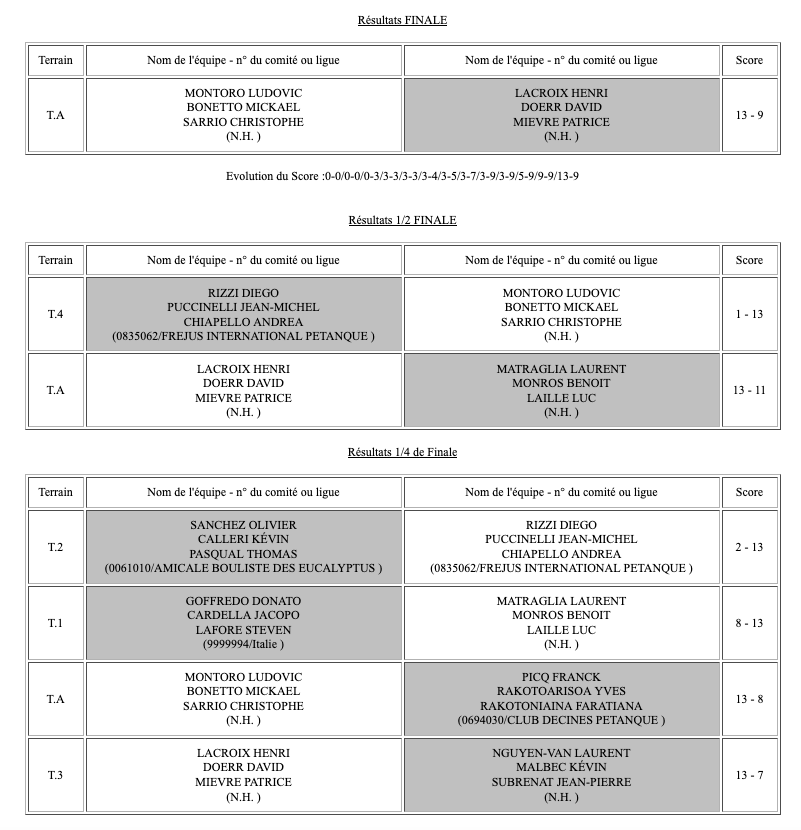
A quelques semaines de s’envoler en Thaïlande pour y disputerle Championnat du Monde en triplettes, l’équipe retenue poutr défendre les couleurs françaises, Montoro, Sarrio et Bonatto, a retrouvé de la confiance en s’imposant dans le très prisé Eutopétanque des Alpes-Maritimes disputé à Cagnes-sur-Mer.
Le Saint-Affricain Elian Angles cherche partenaires pour ce mardi 20 octore à Castres
Elian Angles, sociétaire de l’EPSA, cherche deux partenaires pour aller disputer le concours triplettes vétérans organisé ce mardi 20 octobre à Castres. Si vous êtes intéressés, vous pouvez le contacter au 06 08 08 31 22.
Rectificatif : 32 triplettes qualifiées pour la finale du challenge vétérans de la PJ Millau
Changement de programme à la PJ Millau. Contrairement aux années pécédentes, ce ne sont pas 16, mais bien 32, triplettes qui seront qualifiées pour la journée finale. Chacune des 4 étapes qualificatives – il n’en reste que 2 à disputer les 20 et 27 octobre prochains – ont donc pour ojectif de quelifier 8 formation. Dont acte.
En 2027, au tir (de précision), l’Aveyron… pointera aux abonnés absents
Le traditionnel pré-congrès s’est tenu samedi dernier dans les locaux du siège du comoté départemental.
Drôle d’ambiance samedi dernier rue des Loriots aux Costes-Rouges. Comme dirait l’autre, ça ne transpirait pas la très bonne ambiance, cette atmosphère faite de confiance et de sérénité. Il faut dire que les soucis ne manqient pas dans l’équipe du président Enjalbert. Après les démissions de Francis Molinier, Yves Cazorla et Claude Isnard (des élections doivent avoir lieu lors du prochain congrès), c’est le cas d’une autre élue qui a posé problème. L’arbitre saint-affricaine Marie-Véronique Latil, présidente de la commission d’arbitrage, a en effet fait l’objet d’une mise à l’écart au motif d’une mésentente avec certains de ses pairs. La personne en question, qui conserve son poste de secrétaire générale, apprendra que quand on appartient au comité de l’Aveyron, il vaut mieux se fondre dans le moule, et ce quel que soit le moule, plutôt de vouloir apporter sa touche ou son avis personnels, touche ou avis ausi louables ou constructifs soient-ils. Et oui madame Latil, en Aveyron, çà marche comme ça. Même quand on fait fausse route, il faut marcher droit et faire semblant de rien tant les personnes en place n’aiment ni les vagues de la contestation et encore moins se remettre en question. Bref, on est plus près d’une démarche dictatoriale que vraiment démocratique. Ceci étant dit, ce qui restait de l’équipe (16 élus présents sur les 21 convoqués) ont du se mettre au travail. L’occasion de faire un bilan de la saison en passe de se terminer avec des licences qui ont certes baissé de 40 unités mais qui restent très supérieures à 4 000 licences (4 292 en cette saison 2026). Rodez (-38) et Decazeville (-37) étant les 2 secteurs les plus touchés par ces baisses. Poursuivant consciencieusement leurs travaux, nos dirigeants sont arrivés à une conclusion. L’année ne faisant que 52 semaines, il n’y a, en Aveyron comme ailleurs, que… 52 week-ends. A force d’ajouter, chaque année qui passe, de nouvelles épreuves, le calendrier finit par dire stop. L’impossible n’étant pas possible, il a fallu faire des choix. Et à ce petit jeu, c’est le championnat de tir de précision qui a perdu. Cette épreuve, à la fois chronophage et demandeuse de nombreux arbitres et autres bénévoles, ne verra donc pas le jour en 2027 en Aveyron. Autre information à retenir, la décison d’augmentation du prix des inscriptions aux concours officiels a été entérinée, la part individuelle passant de 5 à 6 euros (12 euros la doublette et18 euros la triplette). Nous avons déjà eu l’occasion de dire et d’écrire ce que nous pensions de cette décision et surtout des explications données pour la justifier. Exemple chiffré à l’appui, nous avons prouvé que cette prise en charge des frais d’arbitrage directement par le comité, et non plus par les sociétés organisatrices, et compte tenu de la non augmentation des grilles tarifaires des arbitres, cachait en fait un moyen de plus de renforcer des caisses d’un comité que l’on sait pourant bien garnies. Et oui, en Aveyron, un sou, c’est un sou. Sacré comité, heureusement qu’on là sinon on s’ennuerait !
C’est reparti pour les concours du samedi à Villefranche
Les concours amicaux en doublettes, organisés en saisons automnale et hivernale, reprennent ce samedi au boulodrome de Villefranche-de-Rouergue. Le président Michel Maquin vous y attend nombreux (Inscriptions, 10 euros, jet du but à 14h 30).
A Santa Susanna, Bruno Pani comme chez lui
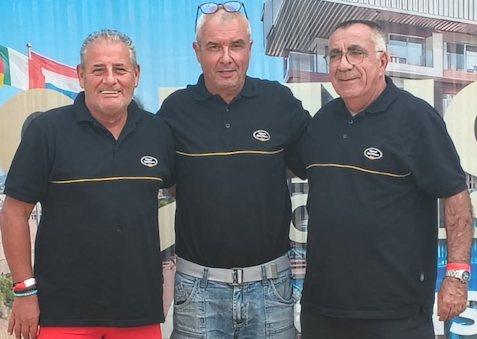
Deux ans après une première victoire en 2024, Bruno Pani, Jean-Marc Medina et Joël Donnet ont en effet récemment partagé un concours ayant rassemblé pas moins de 84 triplettes à Santa Susanna (Catalogne). Félicitations à eux.
Championnat d’Europe féminines en Grèce
Les Françaises placées mais pas gagnantes
Nelly Peyé, Toréa Tairio et Sandrine Poinson échouent au port en s’inclinant en finale contre les Belges déjà tenantes du titre.
A quoi sert un sélectionneur ? D’abord à sélectionner, ensuite à coacher. C’est quoi coacher ? C e n’est pas seulement encourager et féliciter. C’est aussi et surtout anticiper et conseiller. C’est se renseigner sur l’adversaire et en tenir compte. Comment commettre une telle faute d’entrée de jeu ? On parle du jet du but à bien trop courte distance face à des Belges adroites comme des singes. Résultat, six frappes et cinq points plus tard, les Françaises étaient déjà dos au mur (0 à 5 puis 0 à 6). Deux mènes plus tard, c’était pourtant les Tricolores qui réagissaient en montrant leur force de frappe. Six tirs et autant de points faisaient alors de ce véritable bac à sale le terrain d’une parfaite égalité (6 à 6). Une Toréa qui ne manque certes pas mais qui oublie de faire des carreaux, une Nelly qui oublie de rajouter des points pourtant faciles et c’est la Belgique qui a une première opportunité de. gagne. Heureusement, un contre permet à la France d’être encore en vie (7 à 12). Revenues 9 à 12, les Françaises ont eu à leur tour une possiblité de gagner avec le point par terre et quatre boules en main. A l’arrivée, un seul point (heureux) de rajout et un score de 11 à 12. Et là est venu le temps d’une nouvelle erreur de jeu. Contre des Belges dont les seuls trous avaient été faits à longue distace, le bouchon a encore été jeté à plutôt courte distace. Une Sandrine qui engage mal, une Toréa qui pousse sans faire carreau, une Nelly qui se perd inexpliquablement et c’est un bouchon qui reste la seule issue de survie. Un trou et une nouvelle bourde signée Nelly Peyré et les Belges pouvaient se congratuler. Elles venaient de conserver le titre décroché deux ans plus tôt à Santa Susanna. Si les Françaises apprennet à faire plus de carreaux, si les Françaises apprennent à mieux convertir des boules de rajout, si le sélectionneur de substitution, un certain Ludovic Pereirra, apprend ce qu’est vraiment un coach, alors oui, les Françaises peuvent un jour être sacrées Championnes de quelque chose. Pas avant.
Boulodrome intercommunal
Premières pluies, premières fuites
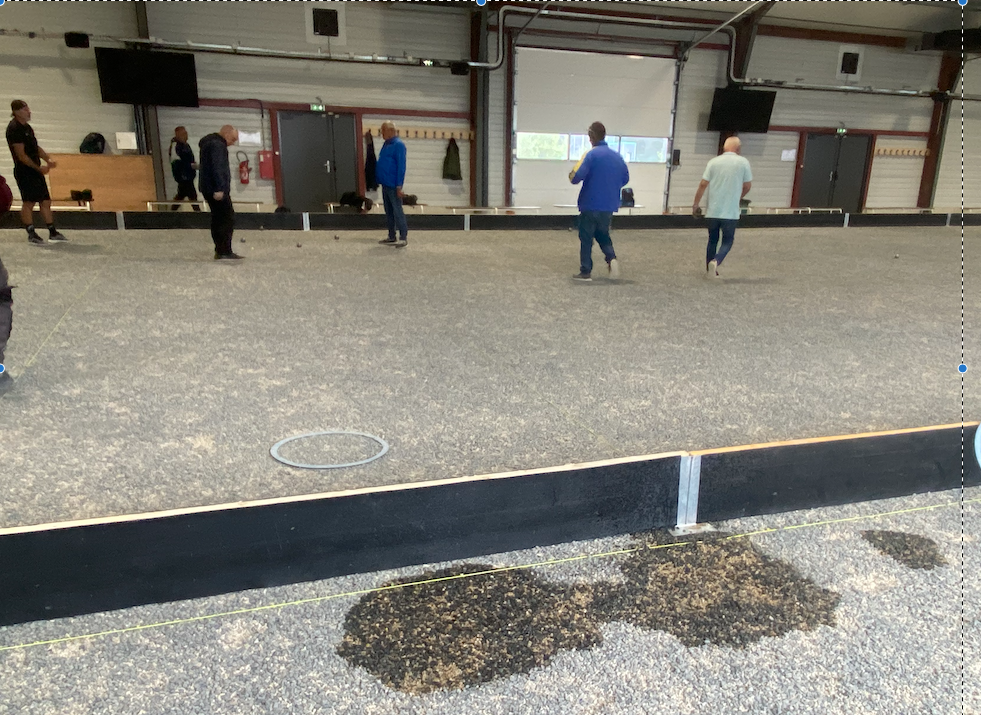
Le tout nouveau tout beau n’aura finalement duré que le temps d’un premier concours, à savoir le Challenge Pierre-Arnal, au boulodrome intercommunal (et non communautaire comme indiqué par erreur chez nos confrères de La Dépêche du Midi). Lundi en effet, la mise en vente des premières cartes d’adhérents en a fait tousser quelques-uns. On pense à ces résidents de l’Agglo qui, parce que licenciés hors du secteur de Rodez, ont du débourser… 80 euros pour gagner le droit de jeter des boules dans la nouvelle structure. Le lendemain mardi, première après-midi consacrée aux « 3 parties » et premières averses de pluie attendues par certains depuis bien longtemps déjà. Sauf que certains autres s’en seraient bien passés. On pense aux dirigeants de l’Amicale gestionnaire du site obligés de constater des premières fuites tout droit venues du toit. Un toit équipé, rappelons-le, de panneaux photovoltaïques et qui avait l’objet de réparation(s) avant la pose de l’actuel faux-plafond. Ce jeudi, des personnes de Rodez Agglo, l’agent territorial Bruno Gares en tête, étaient d’ailleurs sur site pour constater les dégâts. Des dégâts mineurs pour l’instant mais qu’il convient en effet de prendre en compte le plus rapidement possible avant des périodes inexorables de bien plus forte pluie dans les prochains jours ou prochaines semaines. Soyons assurés que le problème est entre de bonnes mains.
Championnat d’Europe Tir de Précision
La Française Nelly Peyré qualifiée pour les quarts de finales
En réalisant le deuxième meilleur score de la phase qualification (36 points), la Française Nelly Peyré, Championne de France tête-à-tête 2026, s’est qualifiée pour les quart-de-finales du Championnat d’Europe Tir de Précisiosn qui auront lieu samedi matin. Elle affrontera alors l’Italienne Sara Ferrera auteur du 7e score. Les 3 autres quarts opposeront la Norvège à la Suède, Israël à la Belgique et la Turquie au Luxembourg. A noter que Nelly Peyré est accompagné du coach Ludovic Pereira, responsable du collectif France Senior Féminin, et non pas par Philippe Quintais, jusqu’à nouvel ordre toujours Directeur Sportif de ce même collectif. Sans cacher sa compréhensible amertume, ce dernier continue à la jouer fair-play en apportant son soutien aux Équipes de France. Chapeai Monsieur Quintais !
Comment le comité use de sournoiserie pour « s’enrichir » encore un peu plus sur le dos des joueurs
Quand on vous dit que politiques et dirigeants de la pétanque ont des comportements de plus en plus similaires ! Les politiques, vous savez ces élus qui, sur fond de promesses et autres mensonges, sont prêts à faire le contraire de ce qu’ils vous ont annoncé. Les dirigeants de pétanque, vous savez ces autres élus qui, derrière un statut louable de parfait bénévole, n’en finissent plus d’aller à l’encontre de l’esprit associatif pour mieux s’endormir sur un épais matelas d’une confortable trésorerie. Dernier exemple en date, la prise en charge, par le comité départemental, de l’indeminsation des arbitres. Jusqu’à présent, ces défraiemets étaient assurés par les sociétés organisatrices en fonction de grilles tarifaires établies par le règlement. Désormais, c’est le CD 12 qui se propose d’indemniser les arbitres à condition que les dites sociétés demandent 1 euro supplémentaire d’inscription aux joueurs.
Un exemple, le Challenge Pierre-Arnal de ce samedi 3 septembre
75 triplettes étaient présentes, 225 joueurs ont donc pris part à ce concours. Si les inscriptions passent de 15 à 18 euros, la société organisatrice collecte donc 225 euros qu’elle devra ensuite reverser au comité départemental qui se chargera alors de rétrocéder aux arbitres les indemnisations dues. Ce samedi au Boulodrome Intercommunal, il y avait deux arbitres. Un Régional et un Départemental qui, toujours selon les grilles tarifaires en vigueur, ont tous les deux droit à une indemnité de… 60 euros. Le CD 12 va donc encaisser 225 euros pour ne décaisser ensuite que 120 euros (2 X 60). Bilan de l’opération, un gain de 105 euros qui ne va guère être affecté par les peu probables frais de déplacement puisqu’il s’agissait de 2 arbitres du secteur de Rodez. Sans tambous ni trompettes mais toujours avec sournoiserie, le CD 12 continue à se mettre de l’argent dans des poches que l’on sait pourtant déjà passablement garnies.
C’est parti pour le challenge triplettes vétérans de la PJ Millau
C’est désormais une véritable tradition. Chaque année en ce mois d’octobre, le site des Coopérateurs à Millau est le théâtre d’un challenge fait de 4 étapes qualificatives pour sélectionner les 16 triplettes vétérans appelées à disputer la finale. La première étape de ces étapes qualificatives se tiendra ce mardi 6 octobre à partir de 14 h 30.
Toutes les dates à retenir
Etapes qualificatives : les mardis 6, 13, 20 et 27 octobre (à 14 h 30)
Finale : le mardi 17 novembre (à 9 heures)
Maintien, ou pas, du concours du 11-Novembre, réponse à la fin du mois
Il figure noir sur blanc sur le calendrier départemental mais aura-t-il vraiment lieu ? Il, c’est le fameux concours du 11-Novembre que le Quatre-Saisons Pétan Club a su faire devenir, au fil des décennies, une véritable institution qui trouve grâce aux yeux de toute l’Occitanie. Le club organisateur en question ne faisant plus partie de l’Amicale gestionnaire, des conditions ont été décrétées pour pouvoir utiliser le boulodromme intercommunal. Parce que le coût de revient journalier de cet outil en fonctionnement a été estimé à quelque 350 euros, c’est la somme demandée aux candidats à l’organisation. Autre condition, il conviendrait d’apporter ses propres boissons, y compris les bières bouteilles puisque les pompes à bière ne seraient pas accessibles. Autant de conditions qui, vous l’aurez compris, pose questions dans les clubs candidats à l’organisation d’un concours. Ces questions, le bureau directeur du Quatre-Saisons Pétan Club se les sont déjà posées lors d’une précédente réunion. Les dirigeants en reparleront en cette fin du mois d’octobre et prendront cette fois une décision quant à l’organisation, ou pas, du concours du 11-Novembre. Nous ne manquerons pas de vous tenir au courant…
National triplettes de Nyons
L’Équipe de France laisse passer sa chance
Un Montoro quelconque à l’appoint et qui manque la gagne au tir (s’il avait cadré), un Sarri sans doute le plus performant mais qui lui aussi manque deux fois la gagne au tir et un Bonetto auteur d’un 15 sur 21 (dont un bouchon manqué) et qui a été assez nettement dominé par son vis-à-vis Adrien Delahaye…, voilà les tenants et aboutissants de cette finale de 21e International de l’Olivier à Nyons. Ces constats et autres statistiques font que la victoire de Pierre Maurel, Jean-Michel Puccinelli et Adrien Delahaye est amplement méritée. Ils nous confortent malheureusement dans nos sentiments. Récemment dominé au tir par Suchaud, Lacroix, Rocher, Cappelaud et maintenant Delahaye, Mickaël Bonetto n’a fait que confirmer ses difficultés à soutenir la comparaison avec les meilleurs. D’où nos certitudes que la France se présentera en Thaïlande en outsider et certainement pas en grand favori. Les Italiens, Malgaches et autres Thaïlandais craignent au plus haut point certains joueurs français. Malheureusement pas tous…
Une finale Équipe de France contre Puccinelli
A ceux qui nous accusent de ne pas soutenit suffisamment l’Équipe de France en pleine préparation des prochains Championnats du Monde, nous allons d’abord répondre qu’un journaliste n’est pas là pour être un supporter de qui que ce soit. Un journaliste est là pour rapporter des faits et autres réalités et, surtout, pour essayer d’anticiper en faisant prendre conscience des enjeux à venir. Quitte à passer pour l’empêcheur de tourner en rond, nous persistons et signons. Non la France ne s’est sans doute pas donnée les meilleures chances de succès en sélectionnant Montoro, Sarrio, Bonetto et Cousin pour aller essayer de récupérer le titre de Champion du Monde détenu par les voisins italiens. Dernier exemple en date, la demi-finale mi-figue mi-raisin disputée à l’instant lots du 21e National triplettes de Nyons. Face aux vétérans briançonnais Boin, Hermitte et Alexio, l’Équipe de France s’est imposée dans la douleur (13 à 11) en montrant ses limites notamment lors d’une mène où pas moins de 6 boules ont été jetées à la mer (1 trou et 5 boules à près de 1 m à l’appoint). Les Haut-Alpins n’en ont pas pleinement profité de la situation (seulement 4 points) sinon… Nouveau test dans une heure (17 h 30, NDLR) en finale face à la triplette Puccinelli – Delahaye – Maurel.
Challenge Pierre-Arnal
Le Lozérien Falimanantsoa premier vainqueur à l’Intercommunal
75 triplettes ont participé à ce concours proposé par le Sébazac Pétan Club.
Alors ce boulodrome, quelle impression a-t-il dégagé auprès des quelque 225 pétanqueurs venus disputer ce Challenge Pierre-Arnal mais aussi venus découvrir cette toute nouvelle structure ? Globaleùent très positive avec, notamment, une sono qui marche (Ça change !) et des écrans qui diffusent les tableaux d’avancée des concours. Côté terrains par contre, les avis sont plus partagés. Nombreux sont en effet ce qui ont trouvé le hall secondaire beaucoup trop fourni en gros gravillons. Certains allant même plus loin en regrettant que l’on ne s’en soit pas tenu au bitume bi-couche déversé sur la plaque en béton. Tous ces gros gravillons plutôt sombres ne faisant de plus que contrarier la luminosité ambiante. Pour le reste, rien à dire. Le « Ruthénoisé dispose d’un bel outil qui va toutefois devoir très vite se pencher sur un problème majeur, le stationnement. Quand on voit une participation certes très honorable emplir déjà tout l’extérieur, on se demande déjà ce qu’il en adviendra quand des terrains extérieurs seront tracés et quand des concours, style les « qualificatifs masters, rassembleront une bonne cinquantaire d’éuipes supplémentaires. Côté sportif cette fois, des Lotois, des Tarn-et-Garonnais, des Cantalous ou encore des Corréziens et autres Lozériens étaient venus défier les Aveyronnais dans leur nouvelle antre. Ce sont d’ailleurs des Lozérisn, en l’occurence Hector Falimanantsoa, Théo Peytavin et Clément Canac qui ont été portés gagnants de cette édition 2026 du Challenge Pierre-Arnal.
Les résultats
Concours A (75 triplettes-
Demi-finales : Falimanantsoa bat Laurent Marsetti, Mathias Croiset et Clément Nespoulous (NH) ; Charrière bat Pablo Michel, Maxime Vanel et Vincent Durand (NH, 12). Finale (partagée et non jouée) : Hector Falimanantsoa, Théo Petavin et Clément Canac (NH, 48) battent Maxime Charrière, Christian Alet et Wilfrid Baldy (NH, 12).
Concours B (56 triplettes)
Demi-finales (partagées et non jouées) : Hervé Grès, Michel Jupin et Antoine Corceiro (FP Le Gua) battent Florent Bernié, Cyrille Costes et Dominique Pourcel (Sébazac Pétan Club, Pétanque Villefranchoise) ; Jean-Claude Contrino, Didier Hortélano et Patrice Pradayrol (FP Le Gua) battent Patrice Luche, Jean-Pierre Cuoc et Alain Revel (Pétanque Villranchoise, Ouest Aveyron). Finale : Contrino bat Grès.
Nouveau boulodrome intercommunal de Rodez : attention, tout ce qui brille n’est pas d’or…

Une naissance, ou alors une renaissance, est toujours un moment de vie très particulier. Un moment fait de joie, de sentiment de devoir accompli mais aussi de projets. Ceux et celles qui n’ont jamais vu et qui vont découvrir, ce samedi 3 octobre après-midi, ce fameux boulodrome intercommunal, qui a tant fait parler tant l’accouchement a été long et difficile, vont être comme éblouis. Ça va sentir le neuf et briller du plus grand éclat, la rénovation et la réhabilitation de ce vieux bâtiment, qui,. rappelons-le, avait plus de 40 ans d’âge apparaitront comme un immense succés. Mais attention, c’est bien connu. Tout ce qui brille n’est pas d’or. Quelle réalité se cache vraiment derrière ce costume d’apparat ? Pour en avoir une première idée, il suffit d’aller jeter un oeil sur le programme dévoilé par le secteur de rodez sur son site internet. En ce mois d’octobre qui compte pas moins de 5 week-ends offrant donc, potentiellement, quelque 10 jours de compétition, un seul concours officiel est au programme, le Challenge triplettes Pierre-Arnal de ce jour. Pour le reste, il faudra se contenter des fameuses « 3 parties » du mardi pour les vétérans et du samedi pour tous. Les raisons d’une si triste réalité ? Ce boulodromme intercommunal reste géré pour l’instant par une Amicale réduite à sa plus simple expression. Les portes de cette nouvelle structure ne sont donc grandes ouvertes qu’aux 4 clubs amicalistes à savoir Les Costes-Rouges, la Boule d’Or, Sainte-Radegonde et le Sébazac Pétan Club. Pour tous les autres, elles pourraient s’ouvrir. Mais à une condition. Que les clubs intéressés mettent la main, ou plutôt les mains, à la poche. On parle en effet de plusieurs centaines d’euros à sortir pour avoir droit de profiter de ce nouvel outil, rappelez-vous si rutillant. Les apparences aussi brillantes cachent-elles une autre réalité beaucoup moins avantageuse ? Le célèbre concours triplettes du »11 Novembre », véritable temps fort de la fin de saison du Quatre-Saison Pétan Club, sera-t-il toujours d’actualité le mois prochain ?. L’actuelle Amicale sortira-t-elle grandie et renforcée après sa prochaine assemblée générale ? Un ou plusieurs clubs feront-ils l’effort financier – on parle de 1 000 euros, NDLR – pour intégrer cette association gestionnaire ?… Autant de vraies questions qui vont conditionner les premiers mois d’existence de ce nouveau-né. En attendant, souhaitons que cette ouverture et le Challenge Pïerre-Arnal qui va avec connaissent tout le succès qu’ils méritent. Pour le reste, il est plus que jamais urgent d’attendre.
Cyrille COSTES
Secteur de Rodez
Le président lance un appel à candidats de renfort
IL y a quelques semaines, nous vous avions fait part des hésitations de Philippe Lopez à poursuivre l’aventure à la tête du secteur de Rodez. S’il se dit prêt, aujourd’hui, à rester aux affaires, il aimerait que la petite équipe qu’il dirige soit plus nombreuse : « Avec Véronique, Romane et Patrick Bories et Françoise Savin, nous ne sommes que cinq. Ce n’est pas assez pour diriger le plus grand secteur du département ». C’est la raison pour laquelle, dasns l’optique prochaine assemblée générale, il vient de relancer les présidents de clubs « ruthénois » pour essayer de susciter des vocations. A bons entendeurs, salut…
Coupe de France : des adversaires haut-garonnais pour les 3 clubs aveyronnais
Le 2e tour de zone de la Coupe de France 2026/2027 se jouera le samedi 15 novembre à 14 h 30. Trois clubs aveyronnais restent en lice et seront opposés tous 3 à des clubs haut-garonnais. La Pétanque Villefranchoise recevra le club de Gaillac. – Toulza, les Pétanqueurs Monteillois accueilleront ceux de Montboron alors qu’Olemps – La Mouline se déplacera à Cazères.
Championnats du Monde seniors masculins en Thaïlande : Montoro, Sarrio, Cousin et Bonetto retenus pour essayer de reconquérir le titre
Alors que Philippe uichaud est au sommet de sa forme – « Je tire comme il y a 20 ans !, nous a-t-il confié très récemment -, alors qu’Henri Lacroix confirme qu’il est bien le meilleur joueur du Monde – Champion de France doublettes et triplettes, vainqueur des Masters…), le directeur sportif du pôle seniors masculins, Didier Choupay, a annoncé, ce mercredi , le nom des 4 joueurs retenus pour défendre les chances françaises lors du prochain championnat du Monde en novembre en Thaïlande. Ont ainsi été retenus Ludovic Montoro, Christophe Sarrio, Pascal Cousin et Mickaël Bonetto. Quand on voit les prérogatives demandées à ceux et celles qui portent les maillots tricolores et quand on voit les attitudes d’un Bonetto qui pense trop souvent à lui avant de servir les intérêts de son équipe, on ne peut que sourire. En espérant ne pas rire jaune en novembre prochain en Thaïlande à l’issue d’un championnat où les Français ne partiront pas avec l’étiquette de favoris mais bien avec celle de simples outsiders.
Infos du Comité départemental : appel à candidatures, augmentation du montant des inscriptions…
Des démissions ayant été actées, le CD 12 va devoir profier de sa future AG du 28 novembre prochain à Séverac d’Aveyron pour élire 3 nouveaux membres. Un appel à candidature est donc lancé, à chages aux présidents de clubs de le relayer auprès de leurs licenciés. Les candidats ont jusqu’au mardi 27 octobre pour officialiser leurs actes de candidature en fournissant les pièces ci-dessous au Comité. Autre information qui risque de faire réagir davantage de licenciés encore, le risque d’augmentation du prix des inscriptions. Le comité se dit en effet prêt à prendre en charge le paiement des indemnités dies annexes (arbitrahe, officiels, gardiennage…) à condition que les sociétés lui reversent un euro par joueur participant au concours. On suppose que les sociétés ne se priveront pas de répercuter cette somme sur le montant des inscriptions.
Exemple : pour un concours rassemblant 70 triplettes, la société organisatrice va encaisser 70 X 3 (5 +1) = 1 260 euros. Sur cette somme, elle dera reverser (70 X 3 X 1) = 210 eurs au comité. Seuls 1 050 euros seront donc rajoutés à l’apport du club pour être reversés aux joueurs.
Pièces à fournir pour candidater (avant le 27 octobre) à l’électioon au poste de membre du CD 12
Extrait n°3 vierge du casier judiciaire, photocopies de la Carte d’Indentité et de la licence, photo d’identité et attestation d’honorabilité
Sélection des masculins au « Mondial »
Henri Lacroix : « Avec Choupay et Rodriguez, j’aurais refusé d’aller en Thaïlande »
A peine diffusée, la sélection masculine pour les Championnats du Monde de novembre prochain en Thaïlande fait déjà réagir. A commencer par un certain Henri Lacroix qui a bien voulu répondre à nos questions et nous expliquer les raisons de ses choix. Henri Lacroix, c’est quelqu’un qu’on ne connait pas vraiment et que l’on connait pourtant si bien. On le connait si bien qu’on le savait capable de refuser une éventuelle sélection. De sélection il n’y eut finalement pas, de mise au point l’heure était venue : « La sélection n’a été diffusée que ce jeudi 1er octobre mais elle est arrêtée depuis fin juin et l’histoire que tout le monde connait. Je n’en fais pas partie et c’est sans doute très bien ainsi. Je me regarde tous les matins dans la glace et je ne me voyais pas faire mon sac et partir en Thaïlande accompagné de gens comme Didier Choupay et Patrice Rodriguez. Partager des repas, faire semblant et se taper dans la main comme si de rien n’était m’était en effet impossible. J’ai ma fierté et mes principes et ces principes ne sont visiblement pas les leurs. La « Fédé » et la DTN, c’est aujourd’hui un manque de courage, de franchise et de transparence. La preuve en deux réalités. Le président Le Bot m’a croisé le jour du Championnat de France triplettes jeu provençal et m’a dit « Je suis de tout coeur avec vous et je ne vous lâcherai jamais ». Quelques jours plus tard, le même président Le Bot a croisé Dylan Rocher à la Marseillaise et lui a dit : « Pour les Jeux Méditerranéens de Tarente, il vaut mieux que vous n’y soyiez pas ». Cet été lors d’un concours jeu provençal chez moi à La Crau, je vois débarquer un certain Didier Choupay soit disant en vacances en famille dans le coin. Droit dans ses bottes et droit dans les yeux, il m’a dit : « Le plus important, c’est de préserver la « Fédé ». A ta place, je les -appellerai et je demanderai à être écarté de l’Équipe de France ». Désolé mais quand on accepte un poste de Directeur sportif payé par la Fédération, on doit être capable d’un minimum de courage. Et non pas de devoir se rabaisser à demander aux autres de prendre des décisions à leur place. Franchement, je ne comprends pas comment un gars qui n’a jamais cessé de baver sur les Bleus et leur équipe peut un jour accepter de défendre les couleurs nationales. Le sélectionneur Didier Choupay et le Directeur Technique National (DTN) Patrice Rodriguez sont sans doute les deux hommes les plus critiqués sur le circuit. Et malgré cela, ils continuent à être protégés par le président Le Bot. Pourquoi ? Comment ? Je n’en sais rien ». Selon nos informations, le responsable du collectif masculin, Jean-Claude Boiron, a téléphoné lundi en fin d’après-midi à Michel Le Bot pour avoir confirmation du fait que les joueurs écartés durant l’été étaient bien sélectionnables ou pas. Aucune réponse. La réponse, il l’a eue quelques heures plus tard en direct dans l’émission« L’Équipe à Polo ». Si cela ne correspond à l’expression « Devoir avaler des couleuvres », notre statut de journaliste mérite d’être remis en question. En attendant que toutes ces anguilles fédérales passent peut-être à l’action, nous poursuivons nos missions d’information. Le journaliste que nous restons et le sélectionneur que nous ne serons jamais se permettent de vous dévoiler qu’elle aurait été notre démarche. Notre priorité aurait été de convaincre un Philippe Suchaud au sommet de sa forme de revenir en Équipe de France seniors. Et nous l’aurions sélectionné en tant que milieu aux côtés de Dylan Rocher tireur et d’Henri Lacroix pointeur. Et quelque chose nous dit que l’Henri Lacroix en question, que l’on ne connait toujours pas vraiment, n’aurait pas refusé cette sélection. Et autre chose nous dit que l’Équipe de France aurait alors eu de vraies chances de retrouver un titre de Championne du Monde. Mais ça, on ne le saura sans doute jamais… En attendant, Henri Lacroix, qui dipute ce week-end le National de Nyons avec Simon Cortès et Laurent Matraglia, adresse tous ses encouragements aux quatre joueurs sélectionnés, Montoro, Sarrio, Cousin et Bonetto. Fair-play cet Henri.
Cyrille COSTES
Journaliste « Pétanque 12 »
4e et dernier livre
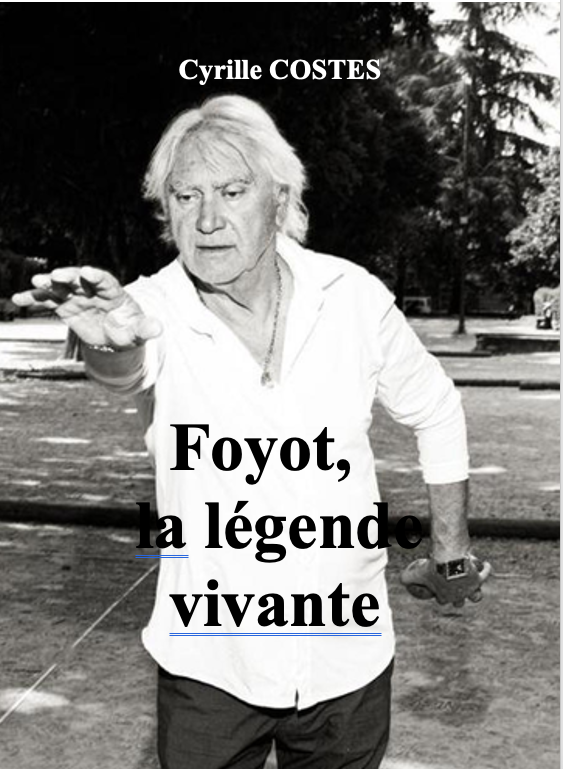
« Foyot, la légende vivante »
Après Philippe Quintais, Philippe Suchaud et Henri Lacroix, les 3 mousquetaires de la « Dream Team », quel 4e homme pour faire l’objet d’un nouveau livre ? Entre « Marco » Foyot et Christian Fazzino, laquelle de ces 2 canailles choisir ? Le Fazzino joueur, rappelons-le élu « Joueur du XXe siècle » en l’an 2000 à Millau, le méritait certainement. Le Fazzino homme ne le valait certainement tant ses valeurs, ou plutôt ses manques de valeurs, ne nous auraient sans doute pas inspiré. Alors, c’est sur l’autre légende du sport pétanuque français que s’est finalement porté notre choix. A l’arrivée plus de 100 pages rédigées sans concessions pour celui qui a été l’incontestale premier globe-trotter de la pétanque à travers le monde. Ses débuts parisiens, ses révélations marseillaises puis sudistes, ses points forts mais aussi ses travers, ses partenaires préférés, « sa » partie de légende, ses anecdotes…, quelques-unes des thématiques abordées dans ce livre à réserverer auprès de Cyrille COSTES, journaliste & auteur (à contacter au 06 21 06 80 65).
Mutations 2026/2027
De la rivière Aveyron à celle du Lot, d’une rive gauche à l’autre…
Parce que le comité départemental ne délivre les premières feuilles dites de mutations qu’en novembre, rien n’est officiel. Parce que rien n’est officiel, le conditionnel sera souvent de mise. N’empêche que certaines « vaguelettes » commencent à se former et que les premières rives et autres berges ne devraient pas tarder à être impactées. Comme les mers font toujours défaut en aveyron, ce sont forcément des rivières qui sont concernées. En l’occurrence l’Aveyron et le Lot. L’Aveyron, qui traverse le Ruthénois avant de s’écouler vers le Villefranchois, pourrait bien être le point de départ d’une première vague qui emporteraient filles et garçons. Chez ces dames et demoiseleles, seraient notamment concernées les Olempiennes Nelly Morgan et Jennifer Vaysset qui quitteraient la Pétanque Olempienne. Chez ces messieurs , ce serait les Villefranchois Thibaut Bories, Dorian Théry et très certainement Florian Valette qui quitteraient le quai du temple et la rive gauche de l’Aveyron repère de la Pétanque Villefranchoise. Ces mises à l’eau seraient logiquement synonyme de l’embarcationa d’un 4e homme, un certain Philippe Bru. Pour quelle destination ? Une autre rive gauche du Nord Aveyron, celle de la rivière Lot à Espalion : « Thibaut, Dorian et Florian se plaisaient à Espalion. Leur départ l’an passé s’est fait à contrecoeur. Je ne cache que leur retour me ferait plaisir », reconnait Robert Costes, président de l’Amicale Pétanque Espalion. D’autres rumeurs font état de pourparlers avec une autre recrue pour le moins prestigieuse. On veut parler d’un ancien Lozérien actuellemnt expatrié en Corrèze, ancien Champion de France triplettes (c’était en 2005) et aujourd’hui jeune vétéran, vous avez forcément reconnu un certain Frédéric Perrin ancien patenaire de joueurs aussi huppés que Fazzino, Suchaud, Quintais et autre Rypen. Les jours et les semaines qui suivent devraient nous permettre d’en savoir davantage sur les tenants et aboutissants de toutes ces transactions actuellement en cours. Si toutes ces embarcations arrivent à bon port sur les rives du célèbre foirail espalionnais, une idée de Team pourrait peut-être voir le jour. Histoire de faire de cette bande de baroudeurs une équipe capable de faire de la Coupe de France, par exemple, un objectif raisonnable. Suite aux prochains épisodes.
La question du jour
La FFPJP est-elle un Titanic en puissance ?
L’émission « L’Équipe à Polo » de ce lundi soir n’a fait que confirmer la véritable cacophonie qui règne en haut lieu dans les instances de la pétanque française.
On pense ce qu’on veut de Franck Polo mais ce passionné a au moins le mérite d’aborder tous les sujets, notamment ceux qui fâchent. Et des sujets qui fâchent, la pétanque française n’en est pas avare ces derniers temps. De la suspicion de paris truqués chez certains de nos élites hommes jusqu’aux guéguerres à se tirer le chignon chez ces dames et demoiselles, la FFPJP a été servie. L’émission retransmise en direct ce lundi soir, avec notamment les interventions du président Michel Le Bot, du « Roi Quintais » et de l’Aveyronnaise Aurélie Bories, n’ a malheureusement pas permis d’apporter réponses à toutes les questions qui se posent.
Michel Le Bot, sans doute gentil garçon, mais sûrement pas un homme au charisme de président
Quand on est président d’une fédération, à plus forte raison quand il s’agit de pétanque, sport populaire de masse s’il en est, il fait se comporter en véritable chef d’entreprise. En se donnant notamment les garanties que ses décisions sont bien comprises par ceux et celles qui constituent la base. En décidant que les joueurs suspectés n’aient plus droit de porter, tout au long de l’été, les couleurs de l’Équipe de France, Michel Le Bot dit aujourd’hui « avoir voulu protéger à la fois l’institution qu’il préside et les joueurs concernés ». Pourquoi ne pas le croire ? Mais pour être crédile, un président se doit d’anticiper les réactions d’une telle décision. Le président en question semble aujourd’hui surpris que le pétanqueurs français aient interprété cette décision comme une mise à l’écart pour les prochaines compétitions et notamment le Championnat du Monde en Thaïlande : « Je ne comprends pas que notre décisioon de déclarer les joueurs concernés sélectionnables puissent entrainer de telles réactions. La « Fédé » n’a jamais prononé le fait qu’ils ne soient pas sélectionnables. Au contraire, le Ministère des Sports nous avait demandé de les suspendre de leurs statuts de sportifs de haut niveau et de les priver des avanatges qui vont avec. Ce que la « Fédé avait refusé de faire ». Quand on n’est pas capable d’anticiper les interprétations de vos décisions, il reste une voie de secours. Être sur les terrains et écouter. Cette voie a visiblement a été aussi écartée et c’est toute une présidence qui perd toute sa crédibilité. Résultats des courses : on n’aimerait pas être à la place des sélectionneurs Didier Choupay et Jean-Claude Boiron qui se retrouvent avec 3 nouveaux sélectionnables dont il va bien falloir étudier les potentialités de sélection. On n’aimerait pas non plus être à la place des Bonetto, Cousin, Sarrio et Montoro qui se voyaient déjà dans l’avion pour la Thaïlande en novembre prochain. Bref, on voudrait semer la zizanie et faire couler le bâteau pétanque que l’on ne s’y prendrait pas autrement.
Philippe Quintais : « Les réseaux sociaux, une solution par défaut »
Accusé d’avoir déballé son mal-être sur les réseaux sociaux, Philippe Quintais a persisté et signé : « Quand je vois ce qui se passe, je ne sais plus ce qui je suis et à quoi je sers. C’est donc normal que je me pose des questions et que j’attende des réponses. J’ai appelé le président, il ne m’a jamais répndu ni jamais rappelé. J’ai envoyé un mail à toutes les personnes concernées susceptibles de m’informer, toujours aucun retour. Avouez qu’il ya de quoi naviguer en plein brouillard ». Effectivement. Quand on voit des joueuses cadres quitter le collectif France, quand on s’adresse à une certaine Nelly Peyré qui décline la sélection, quand on apprend que la même Nelly Peyré accepte ensuite la sélection proposé par un autre soi-disant sélectionneur, on comprend que Philippe Quintais ait besoin d’explications concernant son avenir de Directeur Sportif de l’Équipe de France Féminines. ON comprend aussi son sentiment de mise à l’écart et que la « Fédé » et son président se doivent d’entendre et de comprendre ce besoin de mise au point.
Aurélie Bories : « Des regrets mais certainement pas de déception »
L’Aveyronnaise a expliqué, sereinement et calmemnt, pourquoi elle n’avait pas signé le mail collectif envoyé par apparemment six filles à la « Fédé ». Et préféré communniquer de façon plus personnelle. Elle a aussi dit ses regrets d’avoir sans doute agi dans la précipitation en ce qui concerne ses réactions suite à sa non sélection : « Je reconnais que si c’était à refaire, je n’agirai sans doute de la même manière. Je le regrette et je m’en suis expliqué avec Philippe Quintais. Tout a été mis à plat et il n’y a aucun problème. Par contre,je tiens à préciser que cette non-sélection n’a généré chez moi aucun sentiment de quelconque déception. Et ce pour la bonne raison que je savais qu’on ne ferait pas appel à moi ».
Conclusion : encore et toujours la communication au centre des débats. La comminication est un métier, une affaire de professionnels, et dans le monde amateur notamment, cette affaire n’est pas donné à tout le monde. Loin de là. Attention « Fédé », les icebergs se rappochent et il est grand temps d’agir et de réagir avant qu’ilne soit trop tard. Avant que la pétanque française ne marche dans lesillge d’un bien trop céléèbre Titanic…
L’au-revoir de Valérie Benezech
la Saint-Affricaine Valérie Benezech nous a fait part de sa décison de ne plus être la chargée de communication de l’EPSA. Elle souhaite passer le relais mais continuera à porter haut et fort les couleurs jaune-et-bleues de l’EPSA sur les terrains du département et de la région. En espérant que celui ou celle qui lui succèdera assure ces missions avec le même sérieux et la même régularité. Merci en tout cas Valérie pour ton investissement et pour la qualité des informations toujours transmises notamment à notre demande, pour le site « Pétanque 12 ». En te souhautant bonne chance et pleine réussite pour tes prochains challenes.
Samedi à Rodez, venez découvrir le nouveau boulodrome intercommunal, venez participer au traditionnel Challenge Pierre-Arnal
Lui qui a tant fait pour la pétanque ruthénoise en général, pour le boulodrome de Saint-Eloi en particulioer, aurait sans aucun doute apprécié l’avénement d’une nouvelle sytucture sentant bon le neuf, pour l’instant en tout cas. Pierre Arnal n’est malheureusement plus parmi nous mais son challenge souvenir est plus que jamais d’actualité. Programmée ce samedi 3 octobre, l’édition 2026 va même bénéficier d’un avantage. Celui de garantir à ses partiocipants de se tenir au sec alors que des risques de pluie sont enfin annoncés pour cette fin de semaine et ce week-end. Le boulodrome intercommunal (et oui, il faudra s’y habituer, c’est ainsi qu’il a été maladroitement baptisé !) ouvriar ses portes avant la date officielle toujours fixée au surlendemainn, le lundi 5. En attendant de vous accueillir les plus nombreux possibles (42 terrains seraint disponibles), le Sébazac Pétan Club des présidents Deltort et Martin vous invitent à particuper, ce mardi après-midi à Sébazac cette fois, à leur dernieer après midi d’animation à travers les « 3 parties » en triplettes à la mêmée. L’occasion également, si ce n’est déjà fait, de récuprer vos gains de cette saison en équivalent de bons d’achat dans les commerces partenaires.
Challenge Bourdoncle à Aubin Le Gua
Une participation toujours plus forte, victoire des Monteillois Diaz et Almeida
Elles étaient 83 l’an passé, elles étaient…93 doublettes, ce samedi PLateau des Forges à Aubin – Le Gua, venuesde la Haute-Garonne; du Tarn, du Lot, du Cantale et bien sûr de l’Aveyron. Preuve que ce Challenge Bourdoncle, particulièrement bien primé, connait toujours autant de su;ccès. Sur des terrains toujours aussi exigeants, et sous un soleil finalement plus chaud qu’annoncé, certaines parties ont été longues et âprement disputées. On retiendra une réalité plutôt réconfortante. Au concours A, la victoire s’est jouée entre deux équipes aveyronnaises.
Les résultats
Concours A (93 doublettes)
Demi-finales : Diaz bat Pradayrol – Bories (Fraternelle Pétanque Le Gua) ; Michel bat <larroque, Lemmens (Albi, Gaillac).
Finale : Christophe Diaz et C arlos Almeida-Martins (Pétanueurs Monteillois) battent Pablo Michel et Clément Nespoulous (Flavin, Biscan Pas Saint-Sernin).
Concours B (69 doublettes)
Finale entre Contrino – Vandenberg (FP Le Gua, Villeranche) et Moles – Marin (Leyme, Naucelles).
Le rendez-vous du week-end
Joli concours doubletes ce samedi à la Fraternelle Pétanque Le Gua
Ce sont des conditions idéales qui attendent les pétanqueurs aveyronnais, lotois, cantalous, lozériens… ce samedi Plateau des Forges, à Aubin – Le Gua. Rayons de soleil et quelque 24° devraient en effet être de la partie pour le concours organisé par la Fraternelle Pétanque Le Gua des présidents Bruno Bousquet et Robert Lourenço. Un concours en doublettes fort d’une belle dotation financière (les mises + 750 euros) qui devrait attirer des dizaines et des dizaines d’équipes. C’est en tout lemal que l’on peut souhaiter à la sympathique équipe aubinoise (inscriptions 10 €, jet du but à 14 h 30).
Etat d’âme
« L’affaire » Quintais : un bien triste épisode qui met à nu une pétanque de bien bas niveau
S’il y a en un qui n’est pas surpris par ce qui arrive aujourd’hui à l’ami Quintais, c’est bien nous. Même mieux, il aura fallu attendre d’avoir 60 balais pour se sentir un peu plus proche encore de celui qui a longtemps été notre idole et à qui on vient de consacrer un livre (voir ci-dessus). La jalousie, l’hyprocrise, la trahison, la bêtise, l’incompétence, la méchanceté, le manque de courage et de respect… autant de réalités auxquelles nous, petit journaliste sans prétentions, avons été confronté depuis maintenant 13 ans et le lancement du site d’information « Pétanque 12 ». Toutes ces réalités, nous les avons vécues, les avons relatées et, la plupart du temps, avons été critiqué pour cela. Critiqué par les uns, à notre avis bien trop influençables, punis par d’autres, à notre goût bien trop minables. Quand « Pétanque 12 » tirera le rideau de fin, le site redeviendra alors accessible à tout le monde. L’occasion de vous replonger sur plus de 10 ans d’actualité et de vérités essentiellement départementales qui vous permettrront de voir que ce qui se passe aujourd’hui à l’échelon national et qui touche le « Roi Quintais » n’est qu’une suite inéluctable de ce que avions anticipé et démoncé. S’attacher les services de Philippe Quintais, c’était de l’or en barre pour une « Fédé » qui prétend vouloir rattraper le retard aujourd’hui concédé aux meilleurs. Quintais, c’est le plus grand palmarès au Monde. Quitais, c’est celui qui a accumulé des titres de Champions du Monde à la fois en tant que joueur et que coach des seniors masculins. Quintais, c’est le coach qui a accompagné les vétérans au titre de Champion d’Europe triplettes. Bref, Quintais c’est Quintais, une icône, une légende, une référence, une chance… Certes, nos références à nous ne sont pas aussi prestigieuses. Nous, petit journaliste « encarté » par le journal Midi Libre pour lequel nous avons produit la fameuse page « Pétanque Hebdo » des années durant. Nous, soit-disant journaliste, accusé par notre « ami » président du Comité départemental d’avoir usurpé ce titre de fonction, de manquer de professionnamisme et de faire preuve d’irresponsabilités. Nous, soit-disant journaliste, empêché de faire notre travail en étant privé d’informations et de branchements et autres connexions aux différents podiums notamment lors des championnats départementaux. Nous, accusé d’une maladie (tiens, tiens comme Quintais !) dont les « métastases auraient une influence négative sur nos écrits » (dixit Nogaret et sa drôle de petite équipe). Nous, interdit par la Castromania, de l’accès 3 mois durant au boulodrome de Saint-Eloi car accusé, à tort, de ne pas avoir payé son abonnement… On en pense et des meilleures. Dans de telles conditions, vous comprendrez que l’on ne se soit jamais senti aussi proche d’un certain Philippe Quintais. Surtout que cette doublette tout simplement iréelle vient de recevoir le renfort d’un 3e homme, et pas n’importe lequel. Un certain « Marco » Foyot qui est le 4e homme à qui nous sommes en train de consacrer un livre. Nos recherches nous ont permis de tomber sur certains autres épisodes faisant de cette autre légende du sport pétanque notre parfait 3e homme pour une triplette qui serait forcément revancharde. Il y a déjà plus de 25 ans, le « Grand Marco » échoue dans sa mission de redonner à la France un titre de Championne du Monde que Madagascar lui avait chipé, un an avant, en 1999. La réaction et les mots adressé par celui qui avait quand même été désigné meilleur joueur du tournoi à un sélectionneur qui ne l’avait pas rappelé, lui avaient définitivement fermé les portes de l’Équipe de France. Bien plus récemment, le même Foyot décroche un double titre de Champion d’Europe en triplettes vétérans. Un autre sélectionneur lui dit alors compter sur lui pour une magnifique passe de trois. Sauf que, quand la sélection sort quelques mois plus tard, « Marco » Foyot est aux abonnés absents. De tels exemples, preuves de ce que l’on a toujours dénoncé comme le « faux culisme » ambiant, la pétanque en regorge. Allez un petit dernier pour bien commencer la journée et bien préparer le week-end qui arrive. On veut parler d’une autre légende, aujourd’hui plus connue sous l’appellation de « Vieille Canaille », un certain Christian Fazzino. Lors d’un échange téléphonique, le Montluçonnais nous avait dit regretter de ne pas avoir pris le temps d’aller dire un adieu à son alter ego Daniel Voisin, ce soit-disant ami partenaire emblématique qui luttait alors contre le COVID. Celui qui avait été désigné « Joueur du XXe siècle » nous avait aussi fait part de son intérêt pour la collaboration proposée dans le cadre de l’écriture d’un livre retraçant sa longue et remarquable carrière : « Votre aide me sera d’un précieux secours. Je rassemble mes dernières archives et je ne tarde pas à revenir vers vous », nous avait alors dit le petit moustachu de Montluçon. Sans nouvelles pendant plusieurs mois, nous apprenions un jour que le livre en question était en vente en librairie. Si ça ce n’est pas un manque de respect et de courage,on n’y comprend vraiment plus rien. Et s’il fallait une dernière preuve que l’individu est coutumier en la matière, il suffit de revenir sur son attitude un matin de Championnat de France triplettes vétérans 2024 à Castelnaudary. A celui qui lui dit son étonnement de le voir remonter sans scrupules aucuns la file d’attente formée par ceux en quête du petit noir matinal, le grand Christian fera du petit Fazzino : « Je ne pensais pas devoir faire la queue puisque je ne suis pas preneur de viennoiseries… ». Petit, très petit, mais à l’image de ce grand joueur qui a oublié d’être un vrai bonhomme. Et des présidents, des dirigeants, des décideurs, des simples élus fans de la Fazzinomania, la pétanque en général, aveyronnaise en particulier, en foisonne malheureusement. Quand le ver est dans le fruit, le fruit ne tarde pas à pourrir. CQFD (Ce qu’il fallait démontrer).
Coupe triplettes mixtes vétérans à Flavin
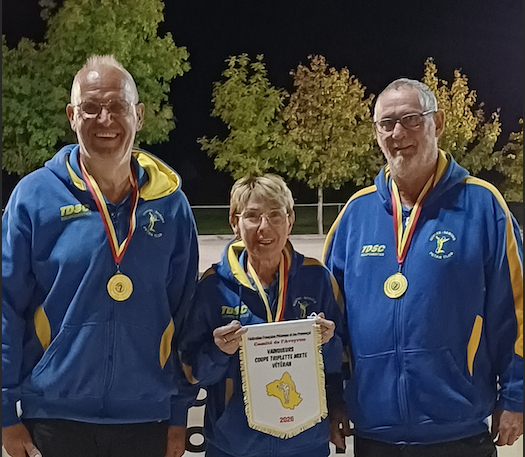
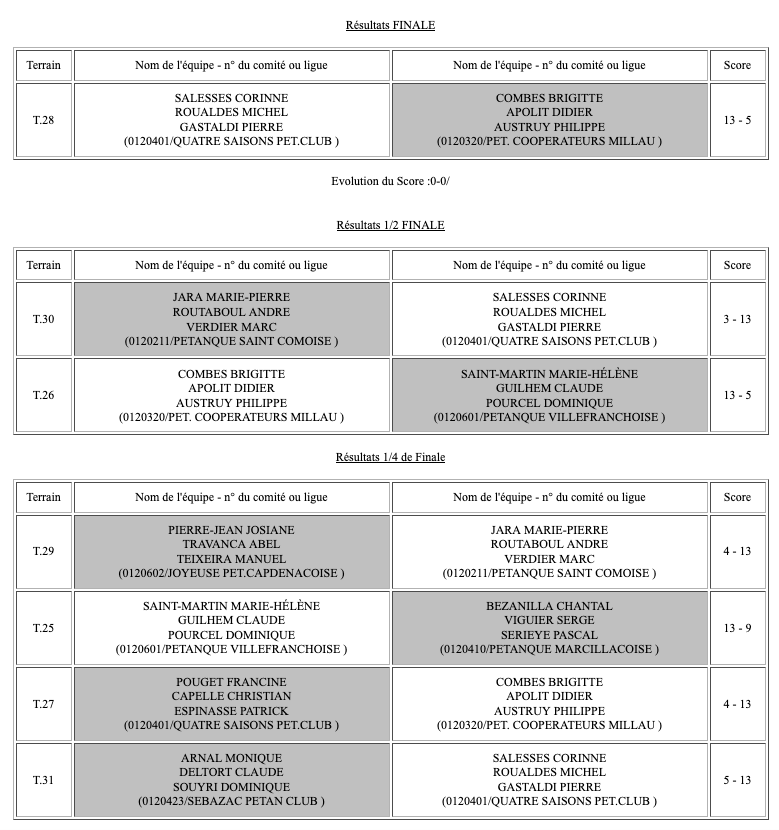
Le doublé pour Salesses – Roualdès – Gastaldi
C’est ce qui s’appelle écraser la compétition. Au cours de leurs trois dernières parties, les tenants du titre n’ont jamais encaissé plus de 5 points. Et encore, ces 5 points n’ont été encaissés que sur une seule lène. C’était en quart de finale face aux Sébazacois Moniue Arnal, Dominique Souyri et Claude Deltort, ce dernier faisant carreau sur une une boule qui valait 4 points. Pour le reste, Corinne Salesses, Michel Roualdès et Pierre Gastaldi n’ont fait que dérouler. Seulement 3 petits points concédés en demi-finale face aux Saint-Cômois de Jara, seulement deux de plus en finale face aux Millavois de Combes et le tour était joué avec un titre conservé et un doublé réalisé. L’autre grand gagnant de la journée n’est autre que la Pétanque Flavinoise, organisatrice de cette compétition. Le soleil et la chaleur aidant, les boissons en général, les fameuses petites bouteilles d’eau en particulier, se sont en effet vendues comme des petits pains.
Les résultats
« Affaire » du collectif féminin
La « Fédé », c’est pas joli, mais la DTN c’est bien pire
Pour s’en persauder – pour ce qui nous concerne, cela fait longtemps qu’on est fixé ! – , il suffit de lire la mise au point publiée par Philippe Quintnais, officielement Directeur Sportif du collectiif féminin. Impossile de revenur ici dans le détail sur cette publication puisque le « Roi Quintais » revient longuement, et précisément, sur les 10 derniers mois de cette collaboration. Mensonges, trahisons, cachoteries, volte-faces, manque de courage et de prise de responsabilités, manque de respect de certaines joueuses, tensions et échauffourées entre d’autres…. on en passe et des meilleures. Messieurs les Gignols, que vous soyez simples élus ou alors salariés, vous ne faites que pourrir l’image de la pétanque. Dans ce contexte, toutes vos règlementations à foison et « à la con » nous font plus que sourire. Elles nous font « pisser » au froc. En attendant, nous nous permettons un dernier conseil. Ne perdez plus de votre sans doute précieux temps à essayer de convaincre des gens valables, sérieux et compétents à venir rejoindre ce véritable bal masqué. C’est tout simplement peine perdue. A bon(s) entendeur(s), salut…
International triplettes Paoli à l’Île-Rousse
L’Équipe de France Montoro – Cousin – Bonetto a remporté cette édition 2026.
38 mènes et 5 petites mènes auront suffi à l’Équipe de France pour s’imposer lors de cet International 2026 de l’Île-Rousse. Opposés à Lucas Desport, Thierry Grandet et Jean-Pierre Soubrenat, les Tricolores ont en fait bénéicié de l’absence totale de ce dernier, pointeur de son état. Perdant les boules deux à deux, ce vétéran n’avait visiblement pas le profil pour joueursur de tels terrains couverts de petits cailloux et propices à l’envoi. Bref, il avait davantage le profil d’un partenaire sponsor que celui d’un joueur chevronné. Et comme Thierry Grandet et Lucas Desport n’ont pas vraiment insisté, cette finale a été comme une parodie de pétanque (2-0, 2-3, 6-3, 10-3, 13-3). Nous ne sommes pas sûr que ce genre de conclusion d’une soit-disant grande épreuve fasse du bien à la pétanque…
La FFPJP touche le fond, Quintais va donner des explications
On dit souvent que l’exemple doit venir d’en haut. Pas étonnant, quand on voit ce qui passe à la FFPJP, que les comités départementaux, le CD12 en particuier, fassent de tout et surtout du n’importe quoi. Dernier scandale en date, le désaveu adressé à un certain Philippe Quintais avec la publication d’une nouvelle sélection féminine après les départs de la sélection décodés par Cindy Peyrot et Angélique Colombet. Pouquoi ces demoiselles ont-elles quitté le navire « France » ? Est-ce lié à une sorte d emise à l’écart de Philippe Quintais ? Ce dernier s’est engagé à donner sa version des faits en tout déut de semaine. Quoi qu’il en soit, une telle cacophonie fait sourire et ne plaide pas en faveur d’une quelconque crédibilité. Une fois de plus. Une fois de trop ? Certains demandent déjà la démission du président Michel Le Bot. C’est tout dire…
A l’affiche ce week-end (hors Aveyron)
Samedi 19 septemre
A Reyrevignes (Lot) .- Concoursdépartementaux en tête-à-tête le matin (8 h 30) et en doublettes l’après-midi (14 h 30).
A Callac (Lot) .- Concoursdépartemental en doublettes (14 h 30).
A Reilhac (Cantal) .- Concoursdépartemental en triplettes mixtes (14 h 30%).
A Bressols (Tarn-et-Garonne) .- Concours départemental en triplettes (14 h 30).
A Beaumont (Tarn-et-Garonne) .- Concours départementaix Promotion en tête-à-tête le matin (8 h 30) et doublettes l’après-midi (14 h 30%).
Dimanche 20 septembre
A Flaugnac (Lot) .- Concoursdépartemental en tête-à-tête le matin (8 h 30) et en doublettes mixtes l’après-midi (14 h 30).
Masters de pétanque 2026
La « Dream Team » en démonstration
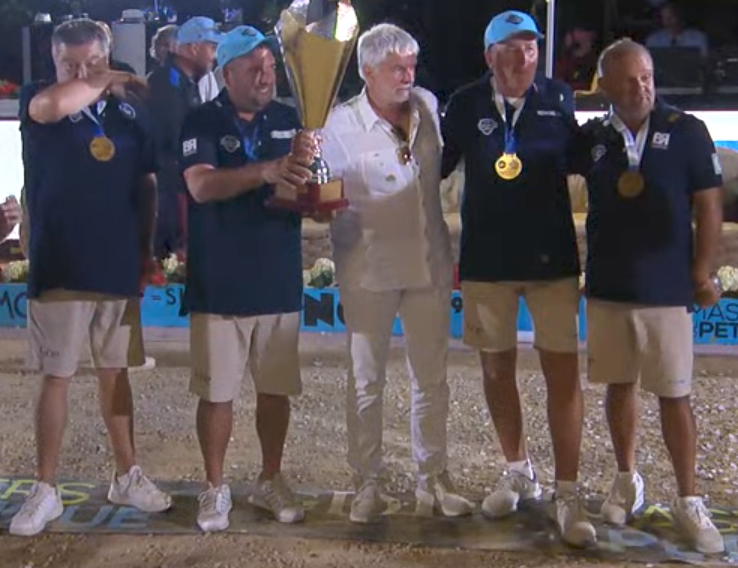
Cinq mènes et quelque 55 minutes de jeu auront suiffi à écrire une nouvelle page d’or dans l’histoire de cette équipe décidément de légende qu’est la « Dream Team ». Une page faite d’or mais aussi empreinte d’émotion comme en témoigne les larmes de Philippe Quintais à l’issue d’une finale qui, une fois encore, a tourné à la démonstration. Trois mènes auront en effet suffi à Philippe Quitaus, Henri Lacroix et Philippe Suchaud (4, 4 et 5 points) pour ramener à la raison Jean-Michel Puccinelli, Diego Rizzi et Dylan Rocher. Ce dernier ne va pas tarder à « cauchemarder » quand il va croiser la route d’un certain Henri Lacroix… Mais aussi quand il verra le tireur Suchaud s’accroupir dans le rond. Et oui, quand Suc haud s’accroupot, le carreau n’est jamais loin. C’est ce qui s’est passé à la dernière mène. Quintais et Lacroix n’avaient plus qi’à jeter pour finir avec une sixième boule dans les mains. Philippe Quintais pouvait essayer de sécher ses larmes, le président Le Bo, loin de l’Île Rousse, pouvait commencer à réfléchir à comment justifier que les 3 meilleurs joueurs du Monde ne fassent plus partie, pour « x » raisons, au collectif France.
Finale des Masters à l’Île Rousse
Une énième affiche Lacroix -Rocher
IIs ne sont plus partenaires mais ne se quittent quasiment plus. Sur les terrains de pétanque en tout cas. Ce sera encore le cas ce soir Place Pascal-Paoli, à 21 heures à L’Île Rousse. La triplette Rocher – Rizzi – Puccinelli a en effet décroché le 2e billet qualificatif pour cette finale des Master 2026. Va-t-on avoir encore droit à ces tirs au but dès la première mène ? Ou alors aura-t-on droit à une partie comme on les aime parce qu’elle allie qualité et suspense ? Début de réponse à partir de 21 heures.
Finale des Mastesrs de pétanque
La « Dream Team » première équipe finaliste
« On vendange ». Qu’est-ce que ça serait s’ils ne vendangeaient pas. En ne concédant que 4 points en 2 parties, la « Dream Team » a totalement écrasé cette poule unique du Final Four des Masters de pétanque. Les seuls à dompter le terrain à l’appoint, les seuls à jouer le vrai jeu de pétanque, les seuls à être solidaires et à jouer les bonnes boules…, Philippe Quintais, Philippe Suchaud et Henri Lacroix continuent à sur jouer et à faire déjouer leurs adversaires. Ils sont les premiers finalistes et joueront les vainqueurs de la partie Rocher contre Bonetto. Finale programmée à 21 heures.
Final Four des Masters pétanque à L’Île Rousse : la leçon de pétanque signée la « Dream Team »
En faisant de la Place Pascal-Paoli une véritale mer de cailloux, les responsables de ces Masters de pétanque s’étaient donnés les moyens d’offrir un grand spectacle. Sur des terrains hyper sélectifs tant à l’appoint qu’au tir, plus de place ni à l’à peu près ni aux fautes de jeu. Ces approximations ne sont pas dans les gênes de la « Dream Team » qui a atomisé d’entrée (13 à 1 en cinq mènes) la formation des Etoiles du Sud qui avait fini première au classement. Un Philippe Quintais impérial à l’appoint (il avait finalement tenu sa place alors qu’il en était pas du tout sûr la veille au soir…), un Philippe Suchaud qui n’a manqué que 2 boules (une coiffée et une manquée au pied) et qui a aligné les carreaux, la triplette associant les Malgaches à N’Diaye n’a même pas eu le temps de souffrir. Avec un meilleur joueur du Monde qui, sous son statut de suspect dans l’affaire que vous savez, rumine sa revanche. La mise à l’écart de l’Équipe de France par la FFPJP est, à notre avis, une grossière erreur. Condamné quelqu’un qui n’a pas été jugé et se passer du N°1 mondial est une faute tout simplement. Si Henri Lacroix venait à être jugé non coupable dans les prochains mois, commençant à nien connaitre le bonhomme dpnt l’amour propre est bafoué, cela ne nous surprendrait pas que ce soit lui qui dise « plus jamais avec l’Équipe de France ». Ou comment une ‘Fédé », soit-disant làn pour redonneleurs lustres aux Équioes de France, devrait devoir se passer de son meilleur atout. Cherchez l’erreur…
Carnet noir
La Fraternelle Pétanuque Le Gua en deuil, l’épouse du président Bruno Bousquet est décédée
Bruno Bousquet, que l’on ne voyait plus depuis longtemps déjà sur les terrains de boules, l’aura accompagnée jusqu’au bout. Le co-président de la Fraternelle Pétanque Le Gua a eu la douleur de perdre son épouse Joëlle à l’âge de 62 ans. Les obsèqies auront lieu ce mercredi 16 septembre à 10 h 30 au crématorium de Capdenac avant un dépôt de l’urne à 14 h 30 au cimetière de Combes.
A Bruno, à ses deux fils Anthony et Guillaume et à toute la proche parenté touchée par ce deuil, nous, journaliste de « Pétanue 12 » adressons nos plus sincères condoléances. Bon courage Bruno et amitiés.
Coupe doublettes vétérans
Contrino – Hortélano oiseaux de nuit
Les Aubinois se sont imposés à 1 h 30 du matin du côté de Salles-Courbatiès.
Maudit Joël Marty ! Déjà finaliste l’an passé en pleine nuit saint-affricaines, le sociétaire de Biscan Pas Saint-Sernin a une nouvelle fois dû se contenter de la médaille d’argent, cette année à Salles-Couratiès. Asssocié cette fois à Thierry Galant, il s’est en effet incliné en finale, sur le coup des… 1 h 30 du matin, face aux jeunes vétérans aubinois, Jean-Claude Contrino et Didier Hortélano (13 à 7). Joël Marty et son compère vont pouvoir analyser les raisos de cette défaite. Plus de 2 heures de route les attendent pour retrouver leurs pénates. Bon courage à eux et félicitations aux Bassinois.
Coupe doublettes vétérans
Une finale Nord – Sud
Les sociétaires de Biscan Pas Joël Marty et Thierry Galant et les Aubions Jean-Claude Contrino et Didier Hortélano, telle est l’affiche de cette finale 2026.
Quelque 17 heures de mobilisation pour plus de 15 heures de jeu, voilà le prix à payer pour briguer ce titre ô comien symbolique de vainqueur de la Coupe doublettes vétérans. Un titre qui ne donne droit à aucune qualification puisque les championnats, qu’ils soient régional ou national, n’existent pas. Ces condions sont-elles raisonnables ? Sans doute que oui puisque 140 équipes s’étaient alignées sur la ligne de départ pour briguer ce titre 2026. A l’arrivée, ce sont deux équipes bien connues qui se disputent la finalepour succéder aux Sébazacois Souyri et Deltort, vainqueurs l’an passé à Saint-Affrique. Alors Marty -Galant de iscan Pas Saint-Sernin ou bien Contrino – Hortélano de la Fraternelle Pétanque Le Gua, réponse, on l’espère dans les plus courts délais.
Coupe doublettes vétérans
Contrino contre Travenca, une finale avant la lettre
Ce derby de l’Ouest Aveyron est de loin le quart le plus explosif de la compétition.
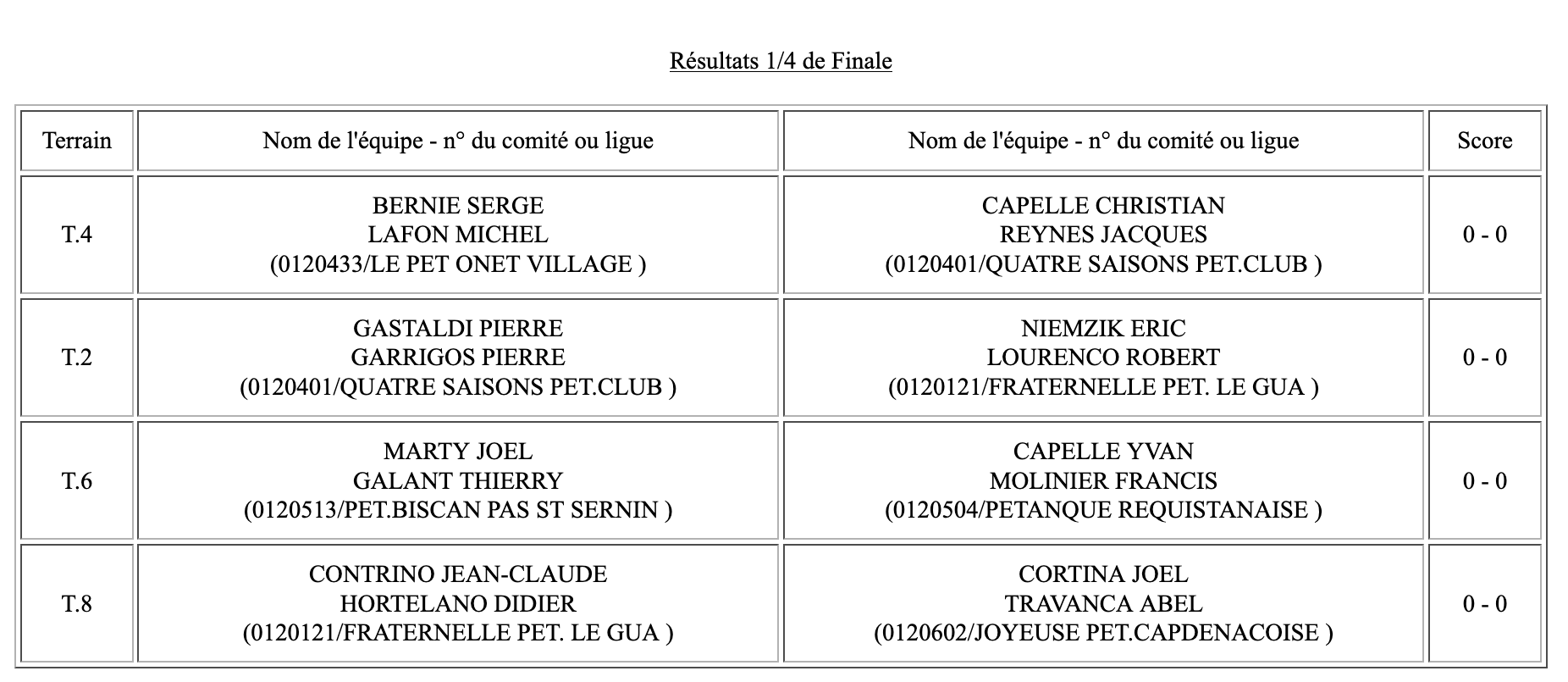
Il est déjà plus de 21 heures et les jambes doivent commencer à être lourdes. Les bras aussi d’ailleurs. Et on ne parle pas des têtes ui ont été exposées, toute la journée durant,au soleil et à la chaleur. Ce ne seront peut-être pas les meilleurs qui l’emporteront, sans doute les plus jeunes, les plus frais, les plus endurants. ON pense évidemment à la doublette guasoise Contrino – Hortélano, équipe aguerrie à souhait qui a prouvé, par le passé, qu’elle savait gagner. Le pronlème, c’est qu’elle va devoir se défaire de la paire capdenacoise Travenca – Cortina qui, elleaussi, ne manque pas d’atouts. A Noterdeux autres derbies, le castonétois entre Bernié et Capelle, et celui du sud opposant Marty et Molinier.
Des nouvelles de Salles-Courbatiès
Les Sébazacois tenants du titre dans le dur
Parce qu’ils ont bien voulu nous rappeler juste avant de reprendre la compétition, nous avons des nouvelles des Sébazacois tenants du titre, Dominique Souyri et Claude Deltort. Vaincus lors de leur première partie, les Saint-Serninois Joël Marty et Thierry Galant vont avoir droit à une revanche puisque les Sébazacois ont trébuché lors de la 2e partie face à 2 vieilles connaissances, les Rieupeyrousains Christian Laumond et Francis Cabaniols. Donc Souyro contre Marty pour savoir qui accompagnera Laumond en sortie de cette poule 34.
Coupe doublettes vétérans à Salles-Courbatiès
Le direct selon ce décidément sacré comité départemental…
Sacré comité départemental ! Selon cette instance dirigeante, cette coupe doublettes vétérans, véritale championnat de la displine, devait faire l’ojet d’un direct. Or, à l’heure où nous écrivons ces lignes (11 h 50, NDLR), cela fait maintenant près de 3 h 30 que le jet du but a eu lieu à Salles-Courbatiès. Nombre d’équipes sont sorties de poules, d’autres sont déjà éliminées, mais le tableau des poules publié sur se site internet du CD12 reste toujours vierhe de toute informations. Si le direct en question ne doit intervenir qu’après poules, il serait tout simple de l’indiquer. Histoire de ne pas tenir en haleine tous les passionnés ui n’ont pas pu être présents à Salles-Corbatiès et qui comptent ien suivre cette compétition à distance.
Quintais, Suchaud et Lacroix, les stars de la « Dream Team », mis en pages

On a beau être des légendes, on n’est pas immortels. C’est la raison pour laquelle nous avons décidé de revenir sur les carrières de ces 3 joueurs légendaires qui ont marqué, et qui marquent encore, les 30 dernières années de l’entre deux siècles. Philippe Quintais, Philippe Suchaud et Henri Lacroix méritaient bien ça. Leurs débuts, leurs premiers titres, leurs records, leurs actualités en cette année 2026, leurs objectifs de fins de carrières… autant de thèmes qui trouvent leurs places dans ces livres de 150 et 80 pages. Si vous voulez tout savoir sur les 3 icônes de la « Dream Team », faites comme un certain Alain Godard, Monsieur foie gras et truffes du Lot. Passez commande de ces livres mémoires (Prix unitaire 20 €).
Contact : Cyrille COSTES (Tél. 06 21 06 80 65 ou mail : cyrille.costes@petanque12.com).
Quel (d)égoût pour Henri Lacroix
Associé à « Ligan » Doerr et Jean-Claude Jouffre, le Varois s’est incliné sur la plus petite des marges (12 à 13) en finale du National triplettes de Carcassonne.
Au-delà de sa place de leader dans ce circuit PPF (2 victoires, une place de finaliste et deux places de demi-finaliste), le sociétaire de La Crau a apporté une nouvelle preuve de son ascendant psychologique pris sur ses principaux « concurrents ». Une fois n’est pas coutume, ce ne sont pas les Fréjusiens Robineau, Rocher et Rizzi qui ont fais les frais de cet ascendant. Ce dimanche à Carcassonne, c’est la famille Feltain, Jessy et « Moineau », et Moïse Helfrick ui, en demi-finale, ont été les acteurs de ce véritale complexe fait à l’égard d’Henri Lacroix. Irréprochales jusqu’alors, les tombeurs d’ Espade, Delforge et Bes en 8e de finales et des Aixoix Riviera, Batista et Pani en quart, semblaient pouvoir proposer une solide oppisition à Lacroix, Doerre te Jouffre en demi-finale. Que nenni ! Il a suffi de 2 carreaux recus de Doerr dès la première mène pour mettre le feu dans les rangs adverses. « Moineau » Feltain qui s’égare en laissant deux points par terre, Moïse Helfrick qui s’en va tirer et manquer… Deux boules contre quatre, cela suffit pour décider de tirer le bouchon. Echec et mat. « Moineau » Feltain qui perd sa dernière boule à plus d’un mètre sur le côté et en laissant deux points à l’adversaire, Jean-Claude Joufre et Henri Lacroix n’ont qu’à jeter pour faire carton plein (6 à 0). Sur la deuxième, un trou initial de « Ligan » Doerr (carreau pile à la seconde) oblige ensuite Jean-Claude Jouffre à tirer à 2. Trou du pointeur vétéran (6 à 1). Troisième mène, le même Jouffre perd ses 2 boules sur l’appoint de Jessy Feltain. Doerr et Lacroix décident de se lancer au tir. 4 carreaux plus tard, nouvelle mène de 6 points qui punit le trou d’Helfrick et les nouveaux appoints des Feltain (12 à 1). Quel crédit la pétanue a-t-elle à gagner de tels scénarions. Un pointeur ui manue à la marque et qui, dans la foulée, perd ses deux boules à l’appoint et qui, au bout de 3 mènes, mènent… 12 à 1, franchement, cela ne ressemble pas à grand chose. La finale ne va malheureusement pas aller dans un meilleur sens. Rocher, Durk et Robineau contre Doerr, Lacroix et… Jouffre, soit 5 des meilleurs joueurs du moment aux côtés d’un joueur lambda, cela pose pas mal de questions. La nôtre est en tout cas toute simple. Comment un joueur come Jean-Cmaude Jouffre peut-il prendre du plaisir en affichant ses limites et ses insuffisances aux yeux du plus grand nomre ? Lors de cette finale, tout le monde aura été à son niveau. Les deux tireurs et les deux milieus en sortant le bouchon pour ne pas perdre; Robineau en proposant un jeu plus qu’intéressant et Jean-Claude Jouffre en étant ien trop irrégulier. Henri Lacroix, encore plébiscité pour être désigné meilleur joueur de ce week-end carcassonnais, a bien failli finir en véritable héros. Déjà auteur d’un tir au but, le Varois a en effet récidivé à la dernière mène alors ue Maison Durk n’avait rien trouvé de mieux à faire que de jeter le bouchon à longue distance sur une… bouche d’égout. Le Champion de France triplettes et doublettes ne s’est pas démonté. A sa première il a frappé le bout de buis qui, pris sur une oreille, est venu échoiuer à uelues dizaines de centimètres de la ligne de perte latérale. Pour Henri Lacroix, une telle défaite (12 à 13) avait, on le comprend à plusieurs titres, la saveur d’un vrai (d)égoût.
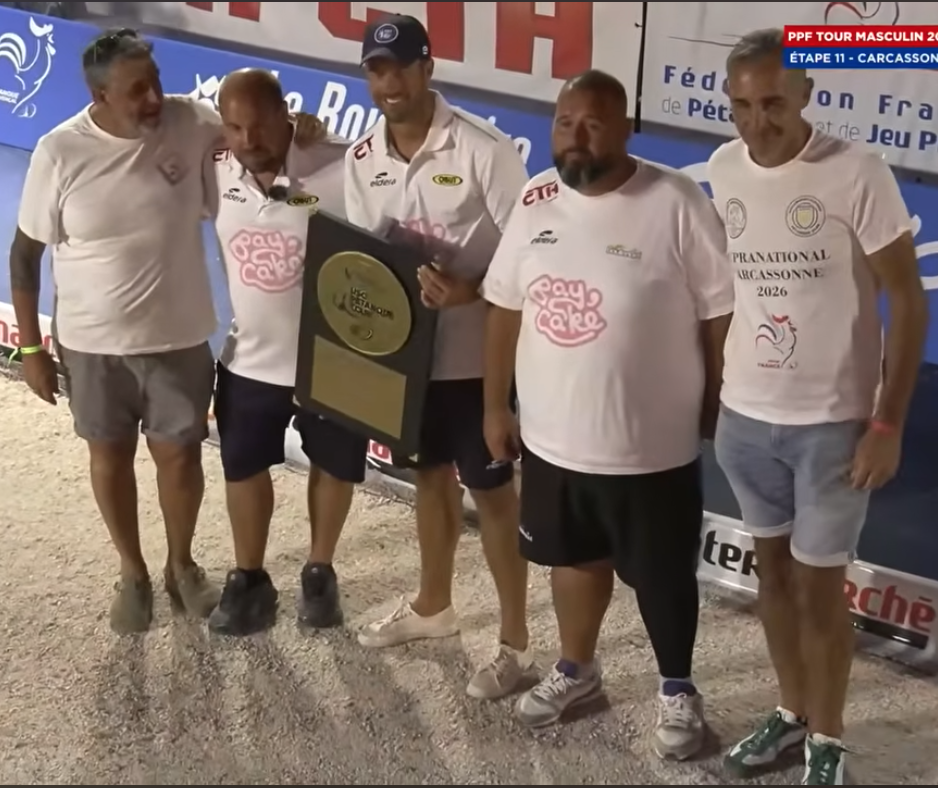
Coupe de France
Belle performance de la Pétanque Villefranchoise vainqueur des Périgourdins de Mussidan
Contrairement à l’an passé, l’Entente Pétanque Mussidan – Saint-Médard ne participera pas cette année au Grand 8 de la finale de la Coupe de France. Le club périgourdin des Valérie Labrousse, Lucas Desport, Jonathan Helfrick et autre Jérémy Darodes a été sorti lors de ce premier tour de zone par les joueurs de la Pétanque Villefranchoise. Malgré deux seules victoires en tête-à-tête et une seule en doublette, les Aveyronnais ont renversé la situation en remportant les deux triplettes sur le score net et sans bavure de 13 à 5. Bravo à Audrey Hernandez, Julien Guilhem, Thibaut Bories, Dorian Théry, Patrice Vandenberg et David Sénézergues pour cette qualification (victoire 17 à 14). .
61 triplettes ce samedi à La Primaube
Victoire de Hilaire, Guilloth et Daudé
Avec 61 triplettes présentes à l’heure des inscriptions, la Pétanque Primauboise des présidents Lionel Durand et Anthony Dutron a encore fait de son rendez-vous une véritable réussite. A noter que si la finale du concours A a été partagée et non jouée, celle du concours a été jouée.
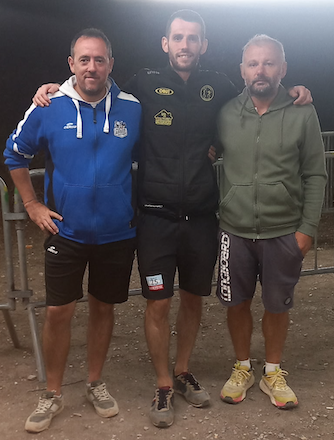
Les résultats
Concours A (61 triplettes)
Demi-finales : Hilaire bat evin Raynal, Jérôme Carles et e,jami Pailhous (Pétanque Primauboise, Pétanque Flavinoise) ; Taghouzi at Eric Védrines, Grégory Corredor et Aurélien Bessou (JB Rieupêyrousaine). Finale (partagée et non jouée) : Yannic k Hilaire, Quentin Guilloth et Antgony Daudé (AP Espalion, Laissac – Bertholène) battent Adel-Malic Taghouzi, Christophe Rascalou et Goran Marinhovi (AP Lévézou Saint-Beauzély).
Concours B (45 triplettes)
Finale (jouée et non partagée) : Pascal et Mathis Crozat, Stéphane Ploncard (Pétanque Primauboise) battent Dylan Loubière, Yohan Carceles et Melvyn Albinet (Olemps – La Mouline).
Vainqueur du National Triplettes Vétérans
Les remparts de Carcassonne n’ont pas résisté à Patric Laur
Patrick Laur n’en finit décidément plus d’être le maillot jaine de la catégorie vétérans. Associé à Francis Duculty et Dominique Lacroix, il vient en effet de se mettre le National triplettes vétérans de Carcassonne (118 équipes) dans la poche. Après avoir battu Philippe Bauer, Ahmed Khadir et Zahere Menari en demi (13 à 12), il s’et imposé en finale face à la triplette Carramano, Bernard et Feniello (13 à 3).
Correction
Le journaliste répond aux « intelligents »
Une faute de frappe. Voilà les raisons de l’erreur commise en entrée du papier initialement paru ci-dessous quand les 1 000 euros sont devenus… 10 000 euros. Plutôt que de nous signaler cette erreur, un lecteur bienfaisant s’est plus à nous faire un commentaire soulignant « encore ue erreur, les informations cela se vérifie ». On aurait aimé une intervention plus intelligente nous signalant précisément notre erreur. Mais nous n’avons pas attendu ce nouvel incident pour comprendre qu’attendre des comportements intelligents de certaines personnes est vraiment trop leur demander. Allez,sans rancune…
A l’affiche ce week-end
Samedi 12 septemre
A La Primaue .- Concours départemental en tripettes doté des mises + 750 €. Inscriptions : 15 €. Jet du but à 14 h 30.
A Villeneuve (au Foirail) .- Dans le cadre des fêtes votives de la bourgade, concoursamical en doublettes formées proposé par la société Ouest Aveyron. Inscriptions : 10 €. Jet du but à 14 h 30.
Dimanche 13
En Aveyron .- ournée de Championnats Départementaix de Clubs (CDC) Open et Féminines.
Mardi 15 septembre
A Salles-Courbatiès .- Coupe départementale doublettes vétérans. Jet du but à 8 h 30. Cette compétition aura pour objectif d’élire les successeurs aux Séaacois Dominique Souyri et Claude Deltort, tenants du titre après leur victoire l’an passé à Saint-Afrique.
Le tirage au sort des poules
Des nouvelles du boulodrome intercommunal
Statu quo sinon rien
Une réunion s’est tenue hier soir en présence du CD12 et des clubs des Costes-Rouges, de Sainte-Radegonde, de Sébazac, de La Primaube, de Luc, des Quatre-Saisons et d’Olemps.
Des droits d’entrée pour le moins dissuasifs (1 000 €, NDLR), des difficutés à mobiliser des bénévoles prêts à donner de leur temps…, autant de raisons qui expliquent que l’on ne se bouscule pas vraiment pour rejoindre une Amicale appelée à gérer le futur boulodrome, Amicale, rappelons-le, forte aujourd’hui de seulement 4 clubs (Costes-Rouges, Sainte-Radegonde, Boule d’Or et Sébazac). Dans de telles condition , la réunion conduite ce jeudi soir par Bruno Gares (Rodez Agglo) a comme accoucé d’une souris : « Les choses sont comme figées. Cela n’avance pas et ces nouvelles 90 minutes de réunion ne m’ont rien appris de nouveau », témoigne ainsi un des participants. S’il n’y a rien de nouveau, on va donc devoir se contenter de ceque l’on savait déjà. A savoir que plusieurs milliers d’euros de petits cailloux vont être déversés et répartis sur les 42 surfaces de jeu qui ont été confirmées. L’installation de quelque 9 écrans télé est également à venir. Après le passage d’une commission de sécurité, le système d’alarme, particulièrement sophistiqué parait-il, est déjà prêt à se déclencer à la moindre petite alerte. La cuisine et le bar restent encore à être aménagés et les planches d’arrêt de boules à être posées. Tous ces travaux dits de finition expliquent que l’ouverture prévisionnel n’est pas prévue avant le lundi 5 octobre prochain. Et ce même si le Sébazac PC espère encore pouvoir bénéficier de la structure pour y organiser son traditionnel Challenge Pierre-Arnal (concours en triplettes le samedi 3 octore). Suite au prochain épisode.
64 doublettes assurent le succès du 5e Challenge Claude-Gabriagues
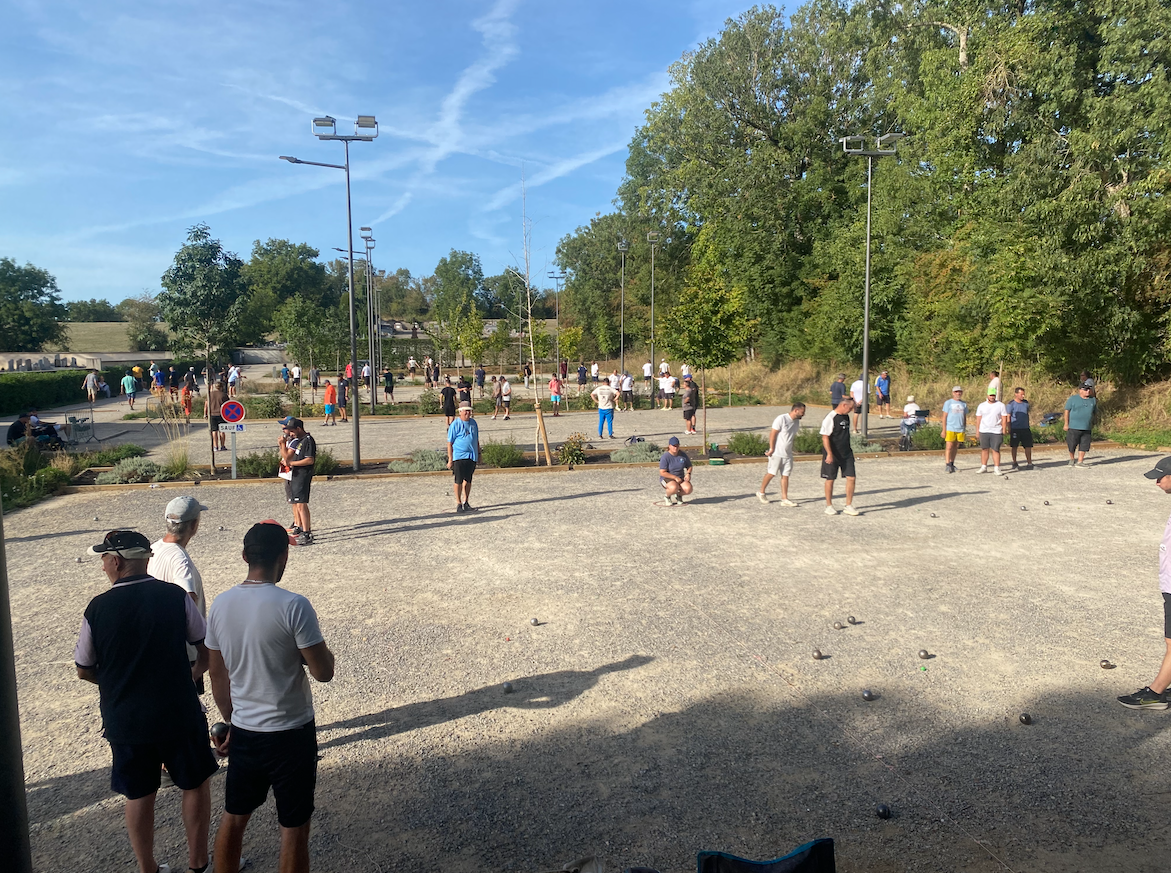
Même si Villefranchois, Decazevillois et Espalionnais se sont fait rares, 64 doublettes ont quand même participé à cette 5e édition du Challenge Claude-Gabriagues. Outre une participation satisfaisante, la qualité du plateau était à relever. D’où des défaites rapides pour certaines équipes huppées et ambitieuses. Ce fut notamment le cas pour Cusin (Parc Albi), Bories (Pétanque Villefranchoise), Durand (La Primaube), Poplin (But du Monastère), Vanel (Creissels) ou encore Corceiro (FP Le Gua). Excusez du peu. Ces faits de jeu ont forcément profité aux outsiders.
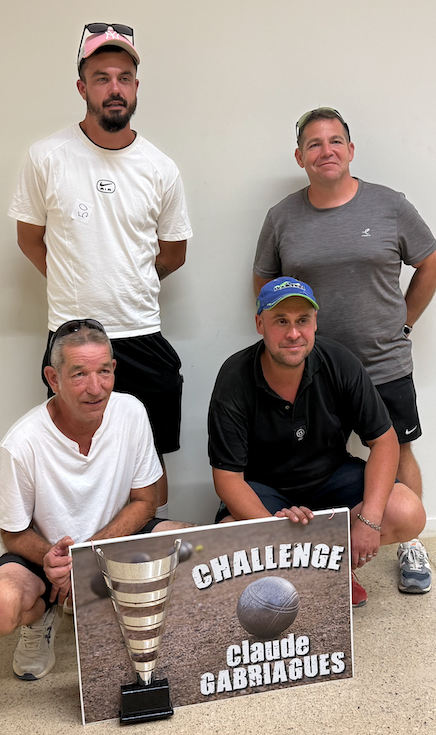
Les résultats
Concours A (64 doublettes)
Demi-finales : Albinet bat pierrot Andriano et Nicolas Banyick (NH) ; Montoya bat Stéphane Ploncard et Anthony Dutron (La Primaube). Finale (partagée et non jouée) : Melvyn Albinet et Didier Malbruno (Olemps – La Mouine) battent Florent Montoya et Guillaume Boned (Saint-Beauzély).
Concours B (48 doublettes)
Demi-finales : Garcia bat Coutou, Roques (Flavin) ; Poplin bat Vanel, Loubières (NH). Finale (partnie jouée) : Fabrice Poplin et Rémy Valette (Le But du Monastère, JB Rieupeyroux) battent Pascal Garcia et Antoine Corceiro (FP Le Gua).
Non sélectionnée pour les Championnats d’Europe, Aurélie Bories réagit, Philippe Quintais lui répond
Ah, sacrés réseaux sociaux! C’est par les réseaux sociaux qu’Aurélie Bories, c’est par les réseaux sociaux qu’elle a réagi avant de faire une mise au point et c’est encore et toujours par les réseaux sociaux que le sélectionneur lui a répondu. L’Aveyronnaie s’est dit surprise et déçue d’apprendre sa non sélection par cette voie médiatique quand l’ancien sélectionneur prenait la peine d’avertir individuellement chacune des candidates potentielles. Philippe Quintais, qui dit regretter d’avoir à utiliser les réseaux sociaux quand les filles ne lui répondent pas (!), se défend en disant avoir utilisé les mêmes voies de communication que celles pratiquées depuis sa nomination au poste de sélectionneur. IL n’a jamais informé individuellement les candidates potentielles à une sélection. Le « Roi Philippe » invite la Saint-Affricaine à l’appeler pour qu’il y ait un échange de vie voix. « Affaire » à suivre…
Challenge Claude-Gabriagues, ce samedi à Onet-Village : on connait les premières équipes
Si la participation reste une grande inconnue, on connait déjà les premières doublettes qui seront de la partie ce samedi après-midi devant la salle des fêtes d’Onet Village. Seront en effet en lice les équipes Lagarde – Marrot (Olemps-La Mouline), Caulet – Bos (Quatre-Saisons), Petit – Coto (Quatre-Saisons PC, Pet Onet Village), Souyri – Reynès (Sébazac, Quatre-Saisons PC), Salles – Albaladéjo (FP Le Gua; Olemps – La Mouline), Archimbeaud – Archimbeaud (Val de Diège Salles-Courbatiès, Pet Onet Village). On sait aussi que l’Olempien Fabrice Caulet et le Castonétois David Solignac seront absents.
Ce samedi à Villefranche, concours de la fête de la Rive Gauche
C’est une tradition à Villefranche. La Rive Gauche de la rivière Aveyron célèbre ses festivités et en profite, via la Pétanque Villefranchoise, pour organiser une concours amical. Initialement prévu sur le parking de la gare marchandises, ce concours en doublettes formée se jouera finalement, ce samedi, au boulodrome couvert (inscriptions : 10 €, jet du but à 14 h 30).
Championnats d’Europe Triplettes et Tir de précision : Quintais dévoile les 4 sélectionnées
Il la connaissait la liste depuis quelque temps déjà mais il a attendu ce milieu de semaine pour la communiquer. Philippe Quintais a choisi C ind y Peyrot, Angélique Colombet, Sandrine Poinsot et Nadège Baussian-Protat pour représenter la France lors des prochains Championnats d’Europe Triplettes et Tir de précision qui se dérouleront en Grèce du 8 au 11 octobre. Cindy Peyrot est sélectionnée pour les 2 championnats et sera celle qui disputera le Tir de précision.
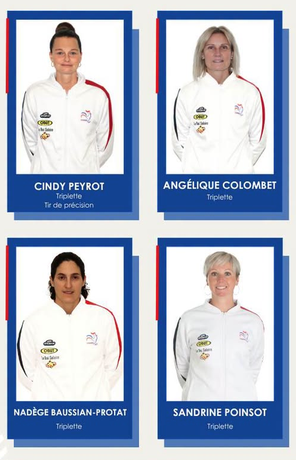
Tout le palmarès détaillé d’un certain Henri Lacroix
Le livre de 150 pages que nous venons de consacrer à Henri Lacroix n’aurait jamais du prendre une forme matérielle papier et n’aurait du exister que sous format numérique. Chaque jour qui passe apporte en effet son lot de nouvelles bonnes… nouvelles qui viennent enrichir une histoire et une carrière plus que légendaire. Un nouveau titre de Champion de France triplettes par-ci, un nouveau sacre de Champion de France en doublettes par-là et, en attendant peut-être un nouveau triomphe aux prochains Masters, voilà un palmarès encore plus exhaustif et plus détaillé qui sort dont on sait où, si ce n’est publié par un certain Philippe Rosenzveig . Ce nouveau document viendra évidemment trouver place au sein du livre titré « Henri Lacroix, c’est le plus fort, un poin(g) c’est tout ». En attendant, découvrez ci-dessous le palmarès hors normes du joueur le plus titré au Monde.
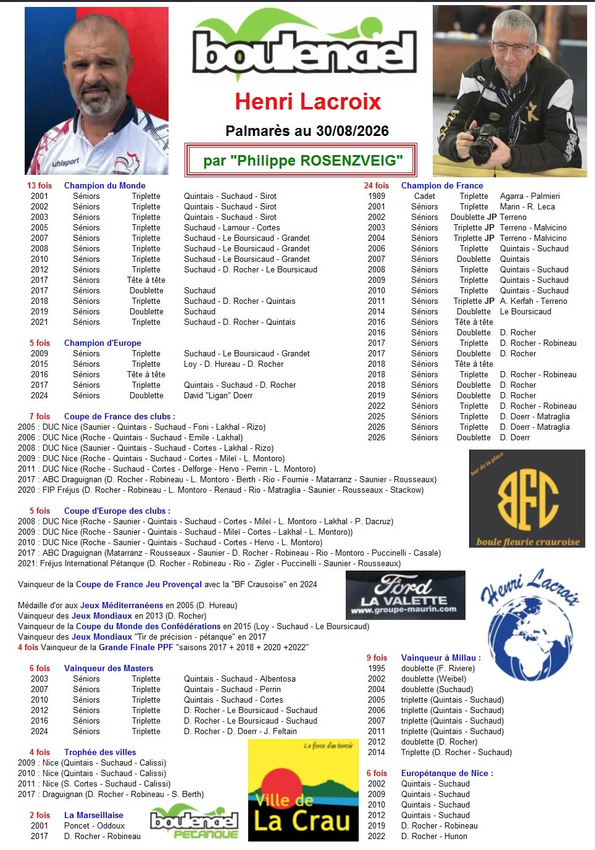
48 doublettes vétérans à Séverac d’Aveyron
Les Castonétois Rabanel et Gastaldi portés vainqueurs
C’est un véritable match Aveyrn – Lozère qui s’est joué ce mardi après-midi au pied du château de Séverac tant la participation a été partagée entre les deux départements. A l’arrivée, ce sont les locaux qui ont dominé le concours A laissant à leurs voisins les faveurs du concours B. A noter la présence du Lozérien rédéric Perrin qui, accompagné de Dos Santos, s’est incliné en quart-de-finales.
Les résultats
Concours A (48 équipes)
Demi-finales : Rabanel bat Michel Séach et Jean-Marie Pirès (Finistère, PJ Millau) ; Delmas bat Francis Molinier et Yves Capelle (Réquista). Finale (partagée et non jouée) : Jean-Pierre Rabanel et Pierre Gastaldin (Quatre-Saisons PC) battent Frédéric Delmas et Bernard Pons (PJ Millau).
Concours B (3 équipes)
Finale (partagée et non jouée) : Arthur Kouyoumdjian et Didier Jaquet (Saint-Germain du Teil) battent Franck Boutet et Vincent Ruel (Mende).

Samedi à Onet Village
5e édition du Challenge Claude-Gabriagues
Cinq ans déjà. Cinq ans que Claude nous a quittés en laissant un si grand vide dans notre vie quotidienne. Sa bonhommie, sa gentillesse et son sourire, tant derrière son bar que partout ailleurs, manquent à nombre de pétanqueurs. Pour entretenir sa mémoire, son club de coeur, le Pet Onet Village, organise, ce samedi après-midi, la 5e édition du Challenge qui lui est consacré (concours doublettes doté des mises + 70%, inscriptions : 10 €, jet du but à 14 h 30).
Le rendez-vous du jour
Concours doublettes Vétérans à Séverac d’Aveyron
A l’initiative de la Pétanque Cheminote de Séverac, un concours départemental en doublettes Vétérans est organisé ce mardi, concours doté des mises + 50%. Inscriptions : 10 €. Jet du but à 14 h 30.
Livre sur Henri Lacroix : une 30e finale et un 24e titre, ça vaut bien quelques pages de plus…
Sacré Henri Lacroix ! Le titre de Champion de France en triplettes nous avait amené à écrire quelques pages de plus dans le livre « Henri Lacroix, c’est le plus fort, un poin(g) c’est tout ». Décidément, le Varois qui disputait dans l’Yonne son 72e Championnat de France et qui a fait de sa 30e finale celle d’un… 24e titre, fait tout pour nous remettre au travail. Dès demain, nous essaierons en effet d’actualiser ce livre en revenant sur ce mémorable week-end-dans l’Yonne.
Championnat de France à Saint-Florentin : Dylan Rocher ou l’histoire d’un complexe et d’une leçon non retenue
Vous êtes d’accord que dans la vie, il y a Masters et Masters. Quand on parle pétanque, on parle de grande épreuve estivale. Quand on parle études, on parle de diplômes de plus en plus prisés par les jeunes étudiants. Dylan Rocher et Diego Rizzi n’ont pas duuser les bancs des grandes écoles. Pas assez de jugeote et surtout insuffisamment de mémoire. Plus qu’importante, la mémoire est capitale. La maxime dit qu’il est bon d’apprendre mais qu’il est meilleur de retenir. Longtemps partenaire d’Henri Lacroix, Dylan Rocher a eu l’occasion d’apprendre. De tout apprendre. Qu’est-ce qu’il a retenu ? Visiblement pas grand chose. Le jeune fait un complexe contre l’ancien et celui qui avait été impérial deux jours durant a encore pris un rond en finale. La mène de six concédée d’entrée, l’an passé en quart à Millau, trotte encore dans les esprits. Jusqu’à réapparaitre cette année en finale à Saint-Florentin. La leçon n’a toujours pas été retenue et on se pose des questions. Comme on a déjà eu l’occasion de l’écrire, Henri Lacroix n’a pas que l’adresse. Il a ce petit plus psychologique qui a fait de lui le leader de la « Dream Team » et qui fait, aujourd’hui encore, la différence. Il a pris un ascendant psychologique sur ses adversaires, notamment sur la paire Rocher – Rizzi qui a bien du mal à soutenir la comparaison. Ce dimanche en tout cas, elle ne l’a pas soutenu. Six et quatre qui font dix plus trois qui font treize. Merci et bonsoir. Plus qu’une nouvelle leçon, une véritable humiliation dont les Varois du FIP pourraient bien avoir du mal à se remettre.
Dans l’individuel féminin, le suspense, lui, a eu sa place. La joueuse de l’Orne, Nadine Talvard, a bien failli rafler la mise en tirant à la gagne. L’opportunité passée, ma solidité et la force de Nelly Peyré ont la différence sur une dernière mène digne des plus grandes (13 à 12).
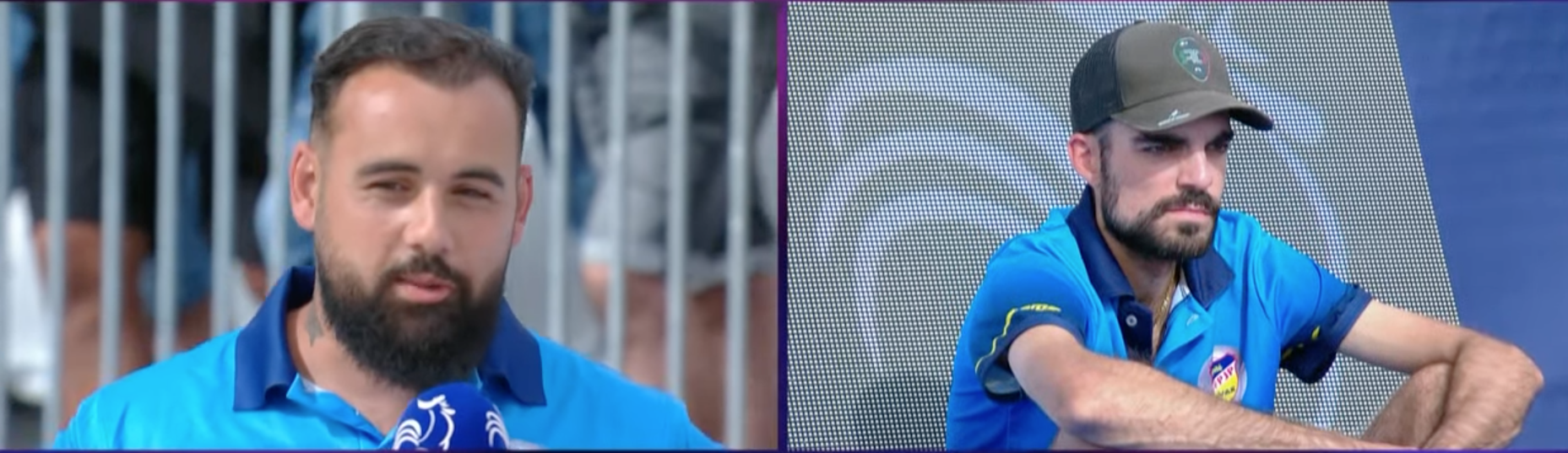
Championnats de France doublettes à Saint-Florentin : Lacroix et Rocher, le grand amour…
Ils ne se quittent décidément plus . Longtemps partenaires, aujourd’hui adversaires, Henri Lacroix et Dylan Rocher ne se quittent plus. Nationaux, Internationaux, Supranationaux, Masters, Championnats de France…, ils partagent des heures et des heures de passion commune. Ces moments de partage vont connaitre un nouvel épisode en cet après-midi de dimanche. Henri Lacroix et « Ligan » Doerr vont en effet enchainer… 4 finales nationales en 2 ans (2 en triplettes et 2 en doublettes) et vont essayer de se parer d’une 3e titre. Si Henri reste sur une défaite contre Dylan en demi-finale du Master, il affiche un bilan positif dans l’ensemble des dernières confrontation. Dylan et et Diego vont-ils prendre leur revanche de l’an passé àù Millau. Cette finale s’annonce en tout cas hautement stratégique. On sait en tout que c’est le département roi, à savoir le Var, qui sera sacré.
ON aurait aussi avoir une finale 100% varoise chez les filles mais Cindy Peyrot a été victime (13 à 12) des tirs à la rafle de Nadine Talvard (Orne). Des tirs qui pourraient bien, en finale, contrarier une Nelly Peyré Vice-Championne de France en titre. Réponse à partir de 14
52 doublettes à Marcillac-Vallon
Navarro contre Cusin, un Flavinois contre un ancien Flavinois…
C’est à une bien belle après-midi à laquelle la centaine de joueurs présents ce samedi à Marcillac a eu droit. Sur de véritables terrains de pétanque (hors le terrain de quilles s’entent), ce ne pouvait être que des bons joueurs qui s’imposent. Ce fut le cas et deux joueurs en ont profité pour faire parler de Flavin. Flavin et un de ses hommes forts du moment, un certain Bryan Navarro qui, accompagné du Firminois Nicoals Banyik, a notamment éliminé les Olempiens Lagarde et Albaladéjo. Flavin et un de ses anciens sociétaires, en l’occurrence le désormais Albigeois qui, au lendemain de sa victoire au National vétérans d’Auch, a su encore répondre présent en atteignant la finale.
Les résultats
Concours A (52 doublettes)
Demi-finales : Navarro bat Lionel et Timothé Durand (La Pri:maube)`; Cusin bat Patrick Bos et Jean-Luc Prats (Quatre-Saisons PC). Finale : Bryan Navarro et Nicolas Banyik (Flavin, Firmi) battent Pascal Cusin et Morgan Herbol (Parc Albi).
Concours B (39 doublettes), finale : Nicolas Albaladéjo et Christophe Lagarde (Olemps – La Mouline) battent Jacques Reynès et Stéphan Coto (Quatre-Saisons PC , Pet Onet Village).
Championnats de France à Saint-Florentin
Les Aveyronnais(es) ne sont pas sortis de poules
Cinq parties disputées, une seule victoire pour 4 défaites, un bilan forcément décevant pour la délégation aveyronnaise. Cette seule victoire est celle de Marielle Nicouleau; qui n’a malheureusement pas su confirmer en partie de barrage. Ce barrage, les champions d’Aveyron doublettes n’ont pas eu la chance de le disputer. Partis très en retard dès la première partie (0 à 10 en 3 mènes) contre Helfrick, Damien Azaïs et Florent Combes sont bien revenus (8 à 10) avant d’avo=ir2 mènes à leur avantage. Cet avantage, ils n’ont malheureusement pas su en tirer profit et se sont finalement inclinés 13à 8. La mauvaise nouvelle est finalement venue du cadre à côté où l »autre « grosse » équipe a elle aussi connu la défaite. Contre les Champions de la Ligue Bretagne, les Aveyronnais ne faisaient que neuf points : « Notre élimination ne souffre d’aucune contestation. Mais l’heure est quand même aux regrets tant notre niveau de jeu nous aurait sans doute permis de sortir d’autres poules beaucoup moins relevées. Mais pour sortir de la notre, il aurait fallu être au top et il nous a manqué un petit quelque chose en plus. Tout simplement décevant », conclut, avec lucidité, Damien Azaïs.
Rocher et Lacroix en quart-de-finales
Les Varois, qu’ils soient de Fréjus ou de La Crau, sont comme chez eux dans l’Yonne. Rocher et Rizzi ont impressionné en 8e de finale face aux Occitans de Rathequeber et Faurel. Quant à Lacroix, il a encore une fois été c e monsieur plus qui a fait la différence sur toutes les boules importantes face aux très bons Mosellans Machnik et Albert. Mais ces braves gens, aussi performants soient-ils, ont vu le niveau qu’il fallait avoir pour faire… 5 petits points contre la paire Lacroix – Rocher. Tout cela promet pour demain.
Le tableau des masculins
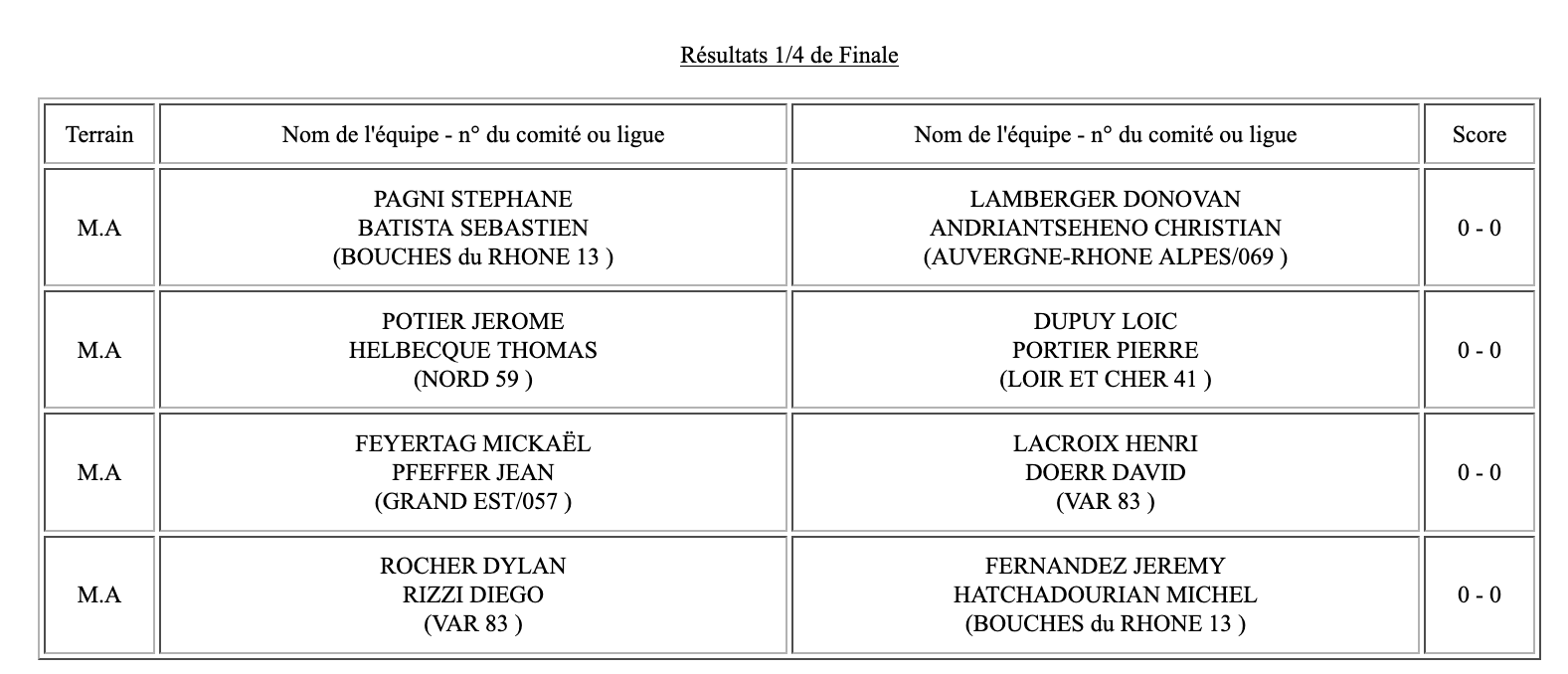
Le tableau des féminines
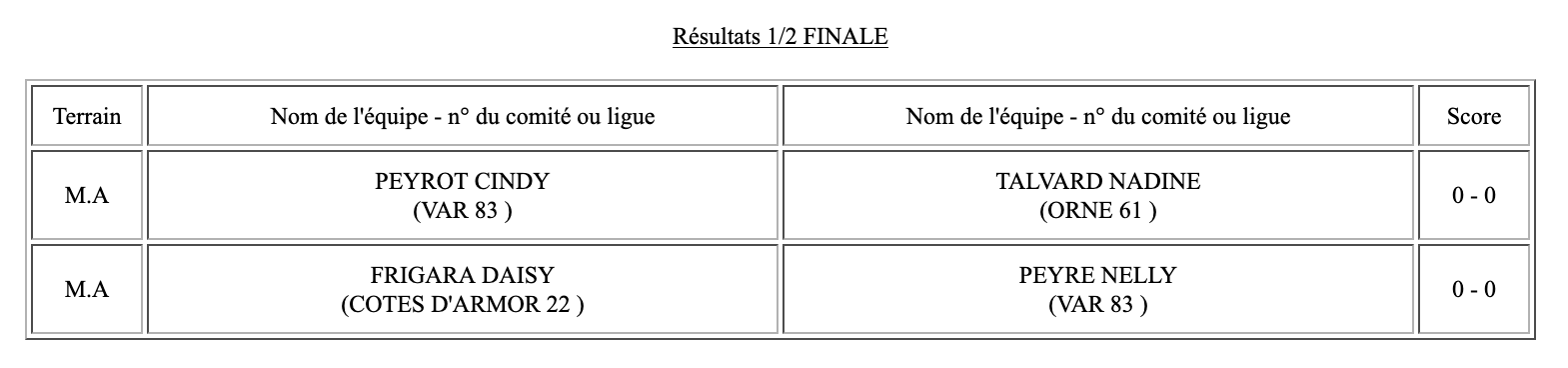
Inédit
Les Championnats de France débutent avec 15 minutes de retard
Chose assez rare pour être soulignée, les Championnats de France doublettes masculins et individuels féminines débutent, ce samedi matin à Saint-Florentin dans l’Yonne, à 8 h 15. Et non à 8 h comme c’est traditionnellement le cas. La raison, le retard de nombreuses équipes en proie à des difficultés de stationnement. Le risque quand on a l’habitude d’arriver au tout dernier moment. Un fait de jeu qui peut paraitre mineur mais qui ne plaide pas en faveur du sérieux et du professionnalisme de la pétanque.
Le rendez-vous du jour
Concours doublettes à Marcillac-Vallon
La Pétanque Marcillacoise organise ce samedi son traditionnel concours en doublettes, concours doté des mises + 50% (inscriptions : 10 euros, jet du but à 14 h 30). On connait déjà 3 équipes qui seront présentes à proximité du collège Pierre-Soulages : Christophe Lagarde – Nicolas Albaladéjo (Olemps – La Mouline) David Solignac – Alexandre Barnabé(Quatre-Saisons PC, Le But du Monastère) et Stéphane Ploncard – Anthony Dutron (Pétanque Primauboise).
L’ancien Aveyronnais Pascal Cusin vainqueur du 1er National Vétérans d’Auch
Auch. Sa belle cathédrale et, depuis cette année, son National Vétérans, étape du circuit PPF, qui a accueilli 137 équipes. Une première édition remportée par l’ancien Flavinois Pascal Cusin, aujourd’hui sociétaire du Parc Albi. Avec ses partenaires Jean-Paul Paloc et Didier Graviou, l’Albigeois s’est imposé en finale face à Dominique Vinçon, Joël Barrier et Yves Datas – Tapie (13 à 5). Félicitations aux Champions du Tarn.
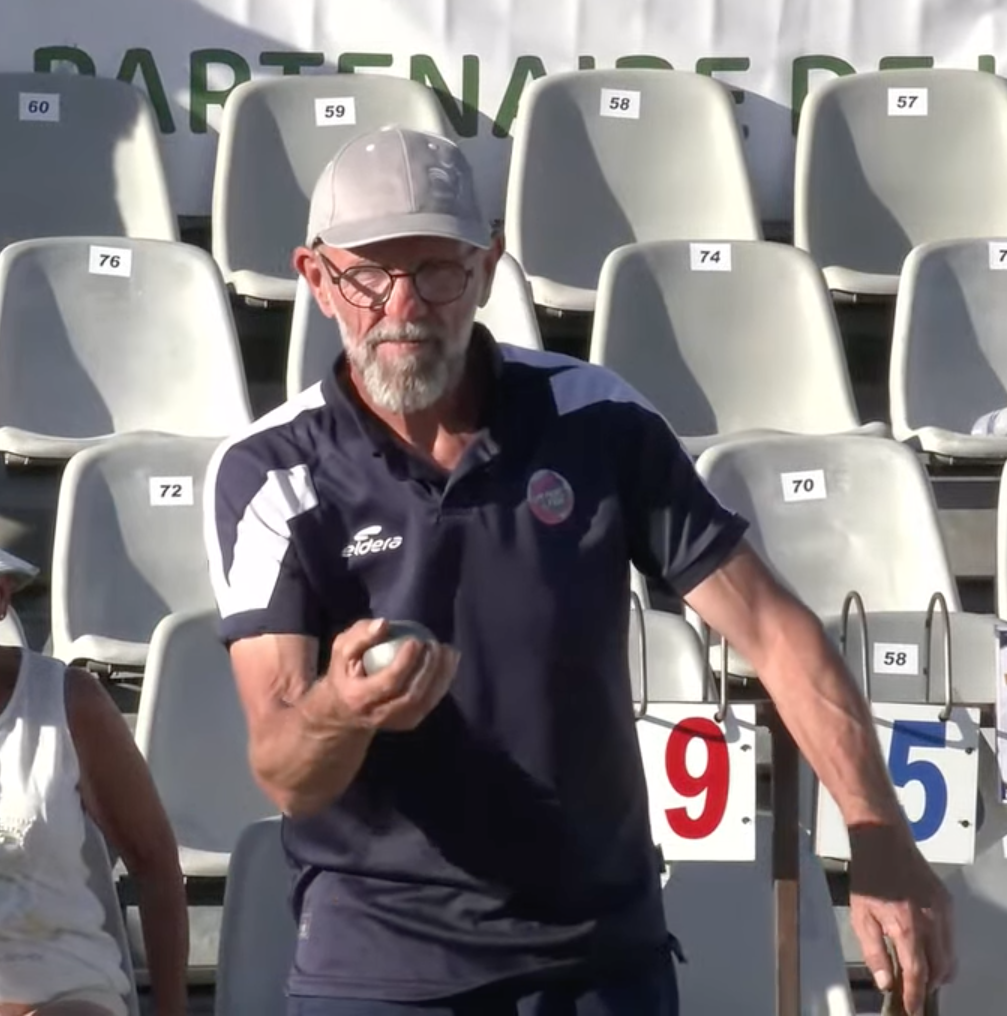
Avant le Championnat de France doublettes à Saint-Florentin
Damien Azaïs : « Ce sera dur mais on est prêt à donner le maximum »

Le sociétaire de la BAC Saint-Jean & Saint-Paul disputera c e week-end à Saint-Florentin (Yonne), son premier Championnat de France senior. Il avait connu cette joie en catégorie Jeunes mais, là, il s’agira bien d’une première. Une première qui s’annonce difficile tant le plateau lui parait « relevé ». Et sa poule 4 semble lui donner raison. Avec son copain « Flo » Combes, il aura comme premier adversaire un certain Moïse Helfrick : « On devra aussi se méfier des Bretons de Joalland qui sont des habitués des Championnats de France. De toute façon, on a parfaitement conscience qu’il faudra jouer notre meilleure pétanque pour espérer quoi que ce soit et on est bien prêt à donner le maximum. Une chose est sûre, la motivation est bel et bien là ». Avec son partenaire Champion d’Aveyron doublettes, Damien Azaïs s’est produit à Séverac, Esalion ou encore à Marciac dans le Cantal. Avec, à l’arrivée, un niveau de jeu plutôt intéressant qui, on l’a compris, il conviendra de reproduire dès ce samedi dans l’Yonne : « On sait qu’on va passer un bon week-end parce qu’on joue en copains mais on sait aussi que cela ne suffira pas et qu’il faudra avant tout être des compétiteurs performants. On est prêts ».
Le tirage au sort des poules
Saint-Florentin accueillera également le Championnat de France tête-à-tête Féminines. L’ Aveyrin sera représenté par la sociétaire de Biscan pas Saint-Sernin, Marielle Nicouleau.
Le tirage au sort des poules
Masters en direct de Nevers
Suchaud contre Bonetto : égaux à eux-mêmes autant dire si différents…
Philippe Suchaud et Mickaël Bonetto ne sont pas sur la même pente.Nous avions déjà eu l’occasion de l’écrire et la première partie de poules ce mercredi soir lors de la 7e et dernière étape des Masters n’a fait que le confirmer. Contrairement à un Suchau au sommet de sa forme (« Je tire comme il y a 20 ans » nous-a-t-il confié hier au téléphone), Bonetto est au fond du trou. » Tant que sportivement qu’humainement. Loin des statistiques de son adversaire tireur (14 sur17 dont de très nombreux carreaux), Mickaël Bonetto a très vite manqué dont une fois double. Mais le pire est survenu dès la deuxième mène. Alors que le bouchon s’était déplacé à quelque 13 mètres en bordure de ligne de fin de cadre, Ludovic Montoro et Christophe Sarrio ont eu le malheur de noyer une boule chacun. Ce qui leur valut des remarques pour le moins désagréables de leur partenaire. Sauf que ledit Bonetto n’a pas fait mieux. Au contraire, il a fait pire. Lui aussi noyé à la première avant de perdre une seconde fois un point de Matraglia à… 1,5 m du bouchon. Toutes ces réalités ne font que conformer nos analyses suite à l’International d’Espalion. Bonetto est un joueur qui joue trop pour lui et pas assez pour son équipe. C’est un joueur qui ne sait pas gagner en jouant pas bien. On n’aimerait pas être à la place de Didier Choupay chargé de sélectionner les joueurs en charge de porter les couleurs tricolores lors du prochain Championnat du Monde en triplettes. Pour la petite histoire, Bonetto n’a pas cherché à se reprendre. Il a demandé à être remplacé et son équipe s’est inclinée logiquement 13 à 8.
Le rendez-vous du jour
7e et dernière étape des Masters à Nevers
Nevers et son esplanade du Palais Ducal accueillent ces mercredi et jeudi la 7e et dernière étape des Masters 2026/2027. Après les demi-finales des féminines en début d’après-midi,, ce sont les hommes qui entrent en piste dans la foulée (présentation des équipes à 18 heures et jet du but à 18 h 15). On rappelle que cette étape est décisive pour la sélection des 4 formations appelées à disputer le » Final Four ».
Livre « Philippe Suchaud »
Allez « Fifi », arrête de « bricoler » et mets toi à la lecture…
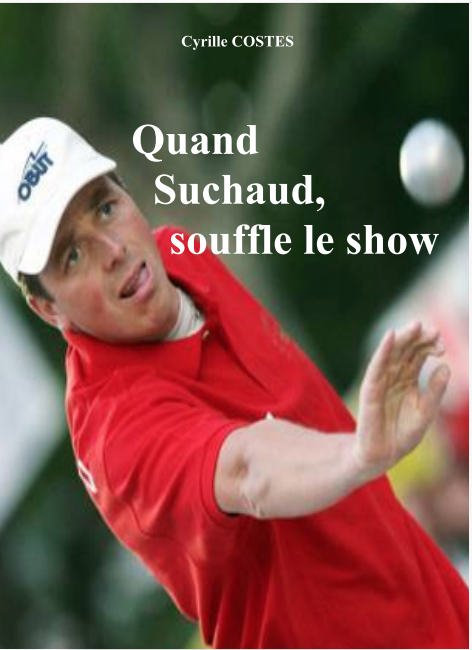
Après Henri Lacroix et Philippe Quintais, Philippe Suchaud. La boucle est bouclée, chacun des joueurs de la « Dream Team » aura eu son livre. Quand on a appelé Philippe Suchaud, ce mardi, pour lui signifier qu’on venait de lui envoyer par mail le livre que l’on venait de lui consacrer, le gars de Cosne-d’Allier s’adonnait à sa passion favorite, le bricolage. Faut bien qu’il bricole un peu à la maison, parce que sur les terrains, il ne bricole pas beaucoup le Philippe. ON en a d’ailleurs profité pour le féliciter pour sa dernière prestation à Rognac à l’occasion de la 6e étape des Masters. Tout simplement exceptionnel et injouable le Suchaud, pour le plus grand plaisir de ses partenaires Henri Lacroix et Laurent Matraglia. Avant la dernière étape à Nevers, Philppe Suchaud aura sans doute eu le temps de lire ce livre intitulé « Quand Suchaud souffle le Show ». Dès sa validation, nous ne manquerons pas de vous le proposer sur le site d’information « Pétanque 12 ». Pensez à le réserver dès maintenant.
Réservation auprès de Cyrille COSTES au 06 21 06 80 65.
Démissions au Comité départemental
Les années se suivent et malheureusement se ressemblent dans les plus hautes sphères de la pétanque aveyronnaise. L’an dernier, c’était le Réquistanais licencié à la Fanny de Ceignac Francis Molinier qui « sentant un malaise s’installer » avait préféré faire valoir ses droits à démission. A croire qu’une quinzaine de mois plus tard, le fameux malaise n’a fait que se confirmer. Le président Gilles Enjalbert ne fait visiblement plus l’unanimité à la tête des siens puisque le Primaubois vient de devoir faire face à 2 nouvelles démissions. Deux des membres du Comité de direction, le Cransacois Yves Cazorla et le Cassognol Claude Isnard, , ont en effet décidé d’arrêter les frais et ont fait part de la fin de leurs participations aux instances départementales. Trois démissions en un peu plus d’un an, une réalité qui pose évidemment questions et qui ne fait malheureusement que confirmer les craintes que nous avions maintes fois eu l’occasion de soulever. Une présidence par défaut et un président qui n’a aucun charisme ne durent qu’un temps et il ne faudrait pas que ce temps soit déjà révolu en Aveyron.
Les résultats du week-end
Bories l’emporte à Carcenac, Corceiro à Montbazens
Malgré la concurrence des concours amicaux à Druelle et surtout à Laissac;, les concours officiels ont connu, ce week-end, des participations plutôt satisfaisantes. Même si le sympathique site de Carcenac, comme ces dernières années d’ailleurs, n’arrive toujours pas à afficher complet (48 doublettes là où 56 étaient possibles).
Les résultats
Samedi 22 août à Carcenac
Concours A (48 doublettes)
Demi-Finales : Bories bat Lutran, Guitard (Pétanque Carcenacoise) ; Barnabé bat Corceiro, Median (FP Le Gua, JP Capdenac). Finale : Thibaut Bories et Jean-Pierre Rabanel (Pétanque Villefranchoise, Olemps-La Mouline) battent Alexandre Barnabé et Anthony Balmes (Le But du Monastère).
Concours B (36 doublettes)
Finale : Lionel et Timothé Durand (Pétanque Primauboise) battent Laurent Pons et Stéphane PLoncard (JB Rieupeyroux, Pétanque Primauboise).
Dimanche 23 août à Montbazens
Concours A
Demi-Finales : Corceiro bat Pradayrol, Dupont (FP Le Gua) ; Meulet bat Férès, Kowalski (JP Capdenac). Finale : Antoine Corceiro et Jean-Larc Medina (FP Le Gua, JP Capdenac) battent Bernard Meulet et Rémy Plas (Cajarc, Fontanes)
C oncpurs B
Finale : Clément Sancerni et Gilles Cavalié (Boulistes d’Olt, Montbazens) battent Bruno Nunzio et Carlo Kevin (Pétanque Villefranchoise, JB Rieupeyroux).
Championnat de France Triplettes Promotion
Les Aveyronnais battus en 32e de finales
Les Champions d’Aveyron, les Réquistanais Alibert, Lartigue et Ribeirinha ont fait à peine un peu mieux que les vétérans quelques jours avant. Sur les mêmes terrains de Saint-Yrieix, ils sont sortis de poules avant d’être battus par les Haut-Garonnais de Klien, Zigler et Benoni. Des Haut-Garonnais ensuite battus par les futurs champions, les joueurs des Côtes d’Armor Hyvon, Paul et Gorry.
Championnat de France triplettes vétérans
A Domicile, les Charentais créent la surprise
Sans doute parce qu’ils son ceux que l’on voit le plus souvent et que l’on connait le mieux, on voyait les Lozériens de Roc he ou les Lotois de Delzers revenir de Charente avec le maillot tricolore sur les épaules. La partie Lozère contre Lot, sorte de finale avant la lettre, a finalement eu lieu en demi-finale. Faciles vainqueurs, les sociétaires de Gourdon Delzers, Couleau et Magaud faisaient alors figure de grands favoris avant la finale. Mais parce qu’aucune partie ne se ressemble, parce qu’il arrive de passer à côté d’une finale, c e sont finalement les joueurs de Charente Louis, Calandre et Duru;isseau qui, à domicile, ont été sacrés Champions de France triplettes vétérans.
National triplettes vétérans de Saint-Juéry
Les Villefranchois de Maquin les plus performants
La triplette villefranchoise Mic hel Maquin, Jean-Michel Marrrot et Michel Delpech aime décidément Saint-Juéry. Il y a 2 ans déjà, cette triplette avait performé aux portes d’Albi. Elle a récidivé hier en atteignant les quart-de-finales de l’épreuve. En 8e de finales, on retrouvait aussi les Saint-Cômois André Routaboul, Marc Verdier et Jacques Espinasse ainsi que le Primaubois Hubert Plisson.
A l’affiche le week-end prochain
Samedi 22 août
A Saint-Yrieix (Charentes) .- Championnat de France Triplettes Promotion. L’Aveyron sera représenté par les Réquitanais Alibert, Lartigue et Ribeirinha.
A Carcenac-Peyralès (et non à Baraqueville comme indiqué sur le calendrier départemental) .- Concours départemental en doublettes doté des mises + 100% (limité à 56 équipes). Inscriptions : 10 €. Jet du but à 14 h 30.
A Laissac .- Concours amicale en doublettes doté des mises + 300 €. Inscriptions : 10 €. Jet du but à 14 h 30.
Dimanche 23 août
A Montbazens .- Concours départemental en doublettes doté ds mises +50%. Inscriptions : 10 €. Jet du but à 14 h 30.
A Laissac .- Concours amicale en doublettes doté des mises + 300 €. Inscriptions : 10 €. Jet du but à 14 h 30.
6e étape des Masters de pétanque
Une « Dream Team » qui n’a jamais aussi bien porté son nom
Un Suchaud stratosphérique et des Lacroix et Matraglia égaux à eux-mêmes ont permis à cette formation de remporter sa deuxième étape après celle de Santa Susanna.
Ne vous demandez plus pourquoi la France ne gagne plus et pourquoi des pays comme Madagascar ou la Thäilande ont soit-disant pris le dessus. La réponse saute en effet aux yeux. Il suffit en effet de suivre un peu l’actualité de la petite boule et on s’aperçoit que pour des raisons « x » et « y », ce ne sont pas les meilleurs qui sont retenus pour défendre nos chances. Robineau qui gagne à Montpellier sans Rocher ni Rizzi, Lacroix qui l’emporte à Trévoux puis à Rognac à l’occasion de la 6e étape des Masters,, un Suchaud de gala tout simplement injouable aux Masters…, autant de joueurs qui, pour telle ou telle raison, ne feront pas partie de l’Équipe de France. Tant que la FFPJP et ses sélectionneurs se tromperont dans leurs choix, il ne faudra surtout avoir de regrets. Nous n’avons rien contre des Montoro, Cousin et autre Bonetto, mais il y a visiblement un véritable plus chez les premiers. Même sans Philippe Quintais, la « Dream Team » possède une aura incomparable. Une capacité à se surpasser tout en contraignant un adversaire à déjouer. Lacroix contre Rocher en demi des Masters, ce fut, à un moment de la partie, 10 mènes sur 11 consécutives à l’avantage du premier. Tout simplement édifiant. En finale, Doerr, Rousseau et Magny n’ont pas fait mieux en n’endossant jamais un air de vainqueurs potentiels. La triplette Robineau – Lacroix – Suchaud ne restera que pure imagination. Elle e verra pas la Thaïlande et les Championnats du Monde de novembre prochain. La France risque encore une fois de revenir d’Asie avec des regrets…
La réaction d’Éric Archimbeaud
« Bien trop insuffisant pour espérer quoi que ce soit »
De cette lucidité dont on vous parlait en présentation de ce Championnat de France Vétérans, les Champions d’Aveyron, éliminés dès les parties de poules, n’en manquent décidément pas. Éric Archimbeaud le premier : « Quelle déception. Et moi qui croyait que la poule était relevée. A l’arrivée, on perd deux fois à 10 en faisant tout sauf vraiment jouer aux boules. Ce ne sont pas les adversaires, plus qu’abordables, qui nous ont battus, c’est nous qui avons été méconnaissables et qui nous sommes éliminés nous même. Ce n’est la faute ni au terrain ni à l’adversité, simplement la nôtre. Moi en tant que milieu, j’ai quasiment toujours joué en retard de boules. On a tout essayé. On a tourné et joué à tous les postes. Rien à faire. Un véritable cauchemar. Bien dommage en tout cas tant cette épreuve semble très ouverte ».
Championnat de France triplettes vétérans
C’est déjà fini pour les Aveyronnais
Les ambitions étaient mesurées, la déception doit être démesurée. Battus à deux reprises, d’abord contre les Vice-Champions de la Ligue Aquitaine de Le Goff, ensuite contre la formation Bulard de Seine-Maritime, les Champions d’Aveyron Diego Diaz, Eric Archimbeaud et Nicolas Salerno, n’ont pas réussi à sortir de la poule 18. Peut-être que les terrains à priori favorables à un jeu offensif n’ont pas répondu au jeu basé à plutôt longue distance sur l’appoint que comptaient menser les sociétaires de Val de Diège Salles-Courbatiès. On attend la réaction d’Eric Archimbeaud.
International d’Espalion
Quand l’attribution des terrains fait débat
IL est aveyronnais, il a 72 ans et est très en colère. Cette colère, il nous a contacté pour la partager. Tout s’est passé lundi après-midi à Espalion. Le septuagénaire en question dispute le Régional triplettes mixtes et peut savourer sa sortie de poules. Quand on l’appelle, lui et son équipe, pour disputer la partie après poule, c’est un des 6 terrains tracés sur le sable, entre la tribune et le bar du coin, qui leur est attribué. Mauvaise surprise, le cadre est en plein soleil et la température ambiante affole les thermomètres. La partie dure, dure encore, les joueurs souffrent de la chaleur mai s notre Aveyronnais finit par sortir vainqueur. Il pense alors avoir fait le plus dur mais, nouvelle surprise, la partie suivante a lieu toujours au même endroit : « On a passé 3 h 30 de jeu en pleine après-midi en pleine chaleur à souffrir comme c’est pas possible. Ils ne se rendent pas compte que faire jouer des gens d’un certain âge dans de telles condition, c’est prendre le risque de mettre leur vie en danger. Mon partenaire, plus jeune, n’était pas bien, il a un véritable coup de chaud et on a mis un très long moment pour récupérer. Heureusement que je ne suis pas allé au graphique parce que cela aurait pu déraper. J’étais vraiment hors de moi ». A cette indignation, le président Robert Costes a une réponse toute faite : « La personne en question est un joueur de boules et il connait le fonctionnement d’un graphique. Nous ne sommes strictement pour rien dans l’attribution des cadres. C’est l’ordinateur qui tire au sort l’attribution des terrains. Dans un cas comme ça, à condition que les 2 équipes soient d’accord, il est possible de venir au graphique oiur faire une demande. A condition de reste calme, posé et poli, à condition aussi que d’autres terrains soient libres, on peut regarder ce qu’on peut faire. Désolé, mais rien de nouveau. C’est le règlement et tous les joueurs sont censés le connaitre ». Fermez le ban. Suite au prochain épisode.
Les vétérans au Championnat de France : des ambitions lucides et mesurées
Les sociétaires de Val de Diège Salles Courbatiès Diaz, Archimbeaud et Salerno défendront les couleurs aveyronnaises à Saint-Yrieix ce mecredi. Et, ils l’espèrent, jeudi…
Et si le 6e était le bon ? Trois décennies – 29 ans très précisément – après leur dernier « France », la triplettes Diaz – Archimbeaud – Salerno retrouve cette semaine les terrains de cette grande compétition. Avec un brin de nostalgie et une bonne dose de lucidité, le tout agrémenté d’une pincée d’ambitions. Nostalgiques, les Aveyronnais le sont forcément car 5 aventures de ce type laissent forcément des souvenirs inoubliables. Même 29 ans plus tard. Surtout quand 2 d’entre-elles ont conduit jusqu’en quart-de-finales. Lucides car ils ont bien conscience que les années sont passées et que le degré de forme n’est plus aussi affirmé. Ambitieux car ils restent persuadés qu’ils sont dans le vrai et que leur vision de la pétanque, vision dite « à l’ancienne » peut encore offrir de belles opportunités : « Notre poule est loin d’être aisée et cela aura le mérite de nous obliger à bien rentrer dans la compétition », lâche ainsi Eric Archimbeau. Bref, on l’aura compris, et pour reprendre un terme très à la mode (Henri Lacroix et David « Ligan » Doerr l’emploient à foison… avec les résultats que l’on sait), pas question de « bricoler ». Ça tombe plutôt bien parce nos trois drôles de types ne sont pas des bricoleurs. Plutôt de vrais joueurs qui ont toujours donné à la stratégie de jeu la place qu’elle mérite. Et là, même 29 ans après, rien n’a vraiment changé : « Nous comptons jouer plutôt loin et compter sur le point. Ce qui ne veut pas dire que la moindre opportunité, si opportunité il y a, ne soit pas tentée et on l’espère réussie », poursuit le même Eric Archimbeaud. Mais aux grands raisonnements, les 3 amis, notamment accompagnés pour l’occasion de leur ancien président espalionnais Robert Costes, préfèrent rester les pieds sur terre : « Notre première ambition sera de sortir de poule, la deuxième de nous qualifier pour la journée de jeudi. Après, on ne sait pas, il y en aura sans doute pour tout le monde et là, on sait jamais tant on se sait capables de tout ». Du meilleur on l’espère…
Le tirage au sort des poules
Jeux Méditerranéens à Torehnte du 22 au 25 août : Auréhhlie Bories non retenue
On a beau faire partie d’un collectif Équipe de France, cela ne garantit en rien une sélection pour chacune des épreuves. L’ Aveyronnaise Aurélie Bories vient malheureusement d’en apporter la preuve. Pour aller défendre les couleurs françaises à l’occasion des Jeux Méditerranéens qui se disputeront à Torente (Italie) du 22 au 25 août prochains. Philippe Quintais, pour les féminines, et Didier Choupay, pour les masculins, ont ainsi retenu Nelly Peyré et Toréa Tairio d’une part et Yohan Cousin et Christophe Sarrio d’autre part.
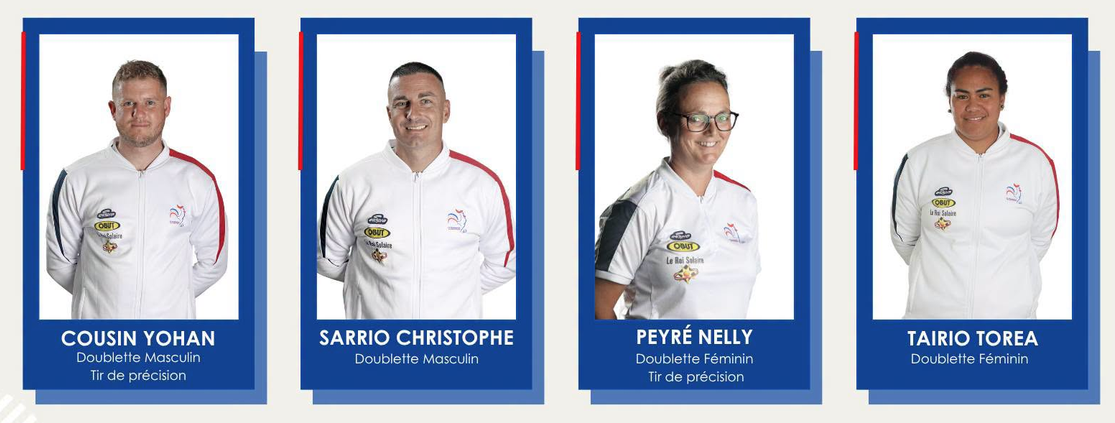
National de Trévoux
Le complexe de la jeunesse face à l’aura des anciens
Dylan Rocher, Henri Lacroix et « Moineau » Feltain ont remporté cette édition 2026.
On espérait une belle finale entre 2 générations de joueurs. Les jeunes Rakotoariniana, Herlemann et Deslys, tombeurs la veille en partie après poule de Laur, Even et Capeleaud, n’auront finalement tenu que 6 mènes et quelque 40 minutes avant d’embrasser « Fanny » face à Henri Lacroix, Jean « Moineau » Feltain et Dylan Rocher. Dur, dur de jouer contre des monuments d’hier et d’aujourd’hui.
National de Trévoux
Lacroix stratégiquement défaillant, Usaï techniquement insuffisant
La 2e demi-finale de cette édition 2026 opposait les triplettes Rocher – Lacroix – Feltain à N’Diaye – Cano – Usaï. Est-ce la fatigue de 2 jours de compétition ou alors la chaleur qui a agi sur les têtes, tout est que la fin de cette partie à donné lieu à des épisodes à montrer dans les écoles de pétanque. En disant bien que c’est surtout ce qu’il ne faut pas faire tant techniquement que stratégiquement parlant… Tout a commencé quand Rocher mène 9 à 4 mais doit faire fac e à une bien mauvaise mène. Un carreau allongé de Cano sur la dernière boule de Feltain donne déjà 4 points à la triplette jouant sous les couleurs d’Arlanc et le pointeur Usaï n’a plus qu’à jeter pour ajouter un 5e point synonyme d’égalisation.Sauf que le pointeur auvergnat commet une grosse faute. Alors qu’il a plus d’un mètre de part et d’autre du bouchon, il ne rien de mieux qu’à venir déplacer ce bouchon de quelques centimètres, se privant ainsi d’un 5e point. Rocher reste devant 9 à 8. A croire que le n’importe est contagieux puisque la mène suivante, c’est la triplette d’un pourtant référent en la matière, un certain Henri Lacroix, qui va commettre une incroyable faute de jeu. « Moineau » Feltain a une dernière boule à jouer et doit gagner un point situé à plus de 50 cm derrière. Et ce pour reprendre 2 longueurs d’avance au score. Feltain, Rocher et Lacroix discutent pourtant là où il n’avait pas à discuter. Les joueurs de l’Équipe de France n’ont en effet qu’une boule dans le jeu et, en cas de contre, ils risquent 3 points. Le risque est grand, l’intérêt est minime car il n’y a pas possibilité de gagner. Le « boss » Lacroix ne s’interpose pas. Feltain tire, frappe la boule mais a le contre. 3 points pour Usaï and Co qui n’en demandaient pas tant et qui prennent les devants (11 à 9). Franchement, on n’aurait pas cru le meilleur stratège du monde en pétanque capable de faire une telle faute de jeu. Comme quoi… Très insuffisant à l’appoint, Usaï n’allait pourtant pas profiter de cette aubaine. En perdant plusieurs fois des points à un mètre du but, il permettait à Rocher, Feltain et… Lacroix de se qualifier pour la finale (13 à 11). A croire que ce Lacroix-là est vraiment né sous une bonne étoile…
National de Trévoux (Ain) : le temps des retrouvailles…
Les Nationaux et autres Internationaux (Le Puy-en-Velay, Espalion, Montpellier, Trévoux…) se succèdent et, comme dirait l’autre, on ne sait pas si les chiens aboient mais ce qu;i est sûr, c’est que les caravanes passent. Emplies de gens qui se ressemblent de plus en plus parce qu’ils sont jeunes, costauds, bronzés, barbus, tatoués et… tireurs. Tout ce beau petit monde laisse une place aux incontournables payeurs, le tout étant que si vous n’avez pas d’argent à faire profiter et si vous n’êtes pas tireur, vous n’avez rien à faire dans ce type de rendez-vous. Ceci étant dit, revenons sur le National de ce week-end à Trévoux. Dans l’Ain. en bordure de la rivière Saône, ce fut le temps des retrouvailles. Après son escapade réquistanaise, un certain Philippe Suchaud a y retrouvé deux rois. Le « Roi solaire », l’incontournable partenaire de PPF, mais aussi le « Roi Quintais » que l’on n’avait plus vu depuis Séverac d’Aveyron. Ces retrouvailles ont permis de revoir le vrai Suchaud, silencieux, concentré et très efficace. Même quand le pointeur adverse se laisse à des commentaires déplacés qui ont bien failli remettre la triplette Championne de France 2013 dans le coup dans une partie qui était en train de lui échapper (6 à 12 puis 11 à 12). Mais les trop grandes insuffisances du pointeur « Manu » Lucien ont fini par être fatales. Toujours à Trévoux, on a eu droit à d’autres retrouvailles. Celles entre un Dylan Rocher, il faut le reconnaitre quelque peu en panne de résultats majeurs ces derniers temps, et un Henri Lacroix. Comme par magie, retrouvez les bons partenaires et tout redevient facile. Ce n’est sans doute pas « Ligan » Doerr », celui qui gagne quand il joue avec Lacroix, qui dira le contraire. Oui mais là il s’est produit aux côtés d’un certain Jean-Claude Jouffre et, sans offenser personne, force est de constater que l’on joue pas dans la même division. Conclusion : Quand Suchaud retrouve Quintais, il redevient lui même. Quand Rocher laisse Rizzi pour Lacroix, il gagne à nouveau. Quand Doerr ne joue plus avec mais contre Lacroix, il ne gagne plus. Ce n’est pas un hasard si la triplette Quintais – Suchaud – Lacrois a été baptisé la « Dream Team ». Parce que composée de 3 joueurs dont le palmarès restera à jamais inégalé, parce que composée de 3 quinquagénaires à la longévité incomparables, parce que faite de 3 stars capables de faire gagner les autres. Et ça, cela n’a pas de prix. N’en déplaise à ces messieurs qui ne s’assument pas être des payeurs…
Réflexion
Médiatisation à tout va : pourquoi la pétanque se fait du mal…
Une bonne communication suppose un bon « mix » entre sons et images
Qu’il parait loin le temps des premières retransmissions de la pétanque à la télé. C’était au tout début des années 90 avec le Trophée Canal +, les finales des Championnats du Monde et de France. Les images valaient ce qu’elles valaient mais les commentaires étaient assurés par des journalistes professionnels. Et quand ces journalistes professionnels étaient, en plus, de véritables passionnés connaisseurs, on était en plein dans le mille. En écrivant cela, on pense évidemment à un certain Jean-Michel Izoird, journaliste au quotidien régional Midi Libre, qui, des années durant, a commenté ce type de parties sur nombre de chaines télé. Ça parlait français, ça expliquait, ça anticipait les différentes stratégies de jeu possible… Bref, on n’avait pas à se contenter des seuls et répétitifs « Bien tiré » ou des « Bien pointé » lancés par des sans doute braves gens qui s’improvisent à l’occasion commentateurs de circonstance. Et on ne parle du temps passé à dialogué avec les internautes jamais lassés de laisser des commentaires sur les réseaux sociaux. Ou alors à pouffer de rire sur on ne sait à quel sujet quand un binôme est aux commandes. Ajoutez à cela la grande mode qui consiste désormais à équiper les joueurs de micros et là, non seulement on touche le fond mais en plus on commence à creuser… Les « Vas-y chéri » (à son partenaire masculin) alternent avec « Vas-y frérot » ou « Vas-y cousin » et ne donnent alors qu’une envie, zapper pour regarder des sujets un peu moins « bas de caniveau ». Alors oui, les images ont fait d’incroyables progrès et offrent des plans variés qui apportent un véritable plus. Mais tant que la pétanque n’aura pas compris que les commentaires qui vont avec doivent être ceux de professionnels si possible connaissant et aimant la pétanque, cette même pétanque continuera à se faire du mal. Et ne gagnera pas, en tout cas, plus de crédibilité auprès du plus grand nombre.
Le rendez-vous de ce 15 août
Concours amical en doublettes à Comps-la-Grandville
Après le tête-à-tête de ce samedi matin, Comps-la-Grandville enchaine comme le veut la tradition par un concours en doublettes toujours ouvert à tous (inscriptions : 10 euros, Jet du but à 14 h 30).
Autre concours amical de ce samedi 15 août, en doublettes à Séveyrac (commune de Salles-la-Source), jet du but à 14 h 30.
Le rendez-vous du jour
Concours amical en doublettes à Montsalès
Ce vendredi, premier jour des festivités à Montsalés (9 km au Nord-Ouest de Villeneuve), sera l »occasion d’un concours amical en doublettes (inscriptions : 10 euros, jet du but à 14 h 30).
L’anecdote du jour
Quand « Phiphi » ne sait pas qui est « Dodo »…
Allez, c’est parti pour les présentations du jour. « Phiphi », c’est Philippe Suchaud. « Dodo », c’est Dorian Théry. Si ce dernier sait évidemment qui est Philippe Suchaud, l’inverse n’est pas vrai. La preuve, ce mercredi à Réquista à l’annonce d’une partie opposant Manon (Laur) au sociétaire de la Pétanque Villefranchoise. Quandi Patrick (Laur) a de suite relevé l’information lancée au micro, Philippe Suchaud a de suite demandé qui était ce Dorian Théry. Conclusion : on a beau avoir été Champion d’Aveyron, on a beau être Champion de Ligue Occitanie en titre (une des plus fortes de France), on a beau être rentré dans de multiples Nationaux (pas plus tard que trèq récemment en atteignant les demi-finales de l’individuel au Puy-en-Velay), on a beau avoir reçu un compliment d’une figure de la pétanque aveyronnaise qui a perçu chez lui « une dimension nationale »..., on reste encore un illustre inconnu pour l’un des plus célèbres pétanqueurs français. C’est ce que l’on appelle la rançon de la gloire. Et cette rançon est parfois lourde à payer. Courage Dorian, plus le vedettariat sera long à venir et plus les fondations seront solides. Car, c’est bien connu, « Patience et longueur de temps font plus que fore ni que rage ».