
UK Betting Terminology and Its Origins According to Betzoid

The language of betting in the United Kingdom is a rich tapestry woven from centuries of sporting culture, social history, and linguistic creativity. From the racecourses of Newmarket to the smoky bookmaker shops of Victorian London, British gamblers have developed a vocabulary that is at once colourful, cryptic, and deeply revealing of the nations relationship with wagering. Understanding this terminology is not merely a matter of convenience for modern bettors — it offers a genuine window into the social and cultural forces that shaped gambling as a popular institution. Many of these terms have survived for hundreds of years, passed down through generations of punters who embraced them as part of an oral tradition as important as the betting itself.

The Historical Roots of British Betting Language

The origins of UK betting terminology stretch back several centuries, with horse racing providing the earliest and most fertile ground for linguistic invention. Horse racing has been documented in Britain since Roman times, but it was during the reign of King Charles II in the seventeenth century that organised racing truly took hold. Newmarket, which Charles famously patronised, became the cradle of British racing culture, and with it came the first standardised language of wagering. Terms like "odds" and "stake" entered common usage during this period, derived from Old English and Norse roots respectively. The word "odds" comes from the Old Norse "oddr," meaning a point or tip, which evolved to describe the numerical advantage one outcome held over another.

The eighteenth century brought the rise of the professional bookmaker, a figure who would fundamentally reshape betting vocabulary. The term "bookmaker" itself reflects the practice of literally keeping a book — a ledger in which wagers were recorded against specific outcomes. This period also gave rise to "laying" a bet, a term that distinguished the bookmakers role from that of the punter. To "lay" a bet means to offer odds against an outcome, accepting the risk that the event will not occur. This distinction between "backing" and "laying" remains central to British betting culture today, and has experienced a remarkable revival with the emergence of betting exchanges in the early twenty-first century.

Cockney rhyming slang also left an indelible mark on British betting language, particularly in London. Phrases like "monkey" for £500, "pony" for £25, and "carpet" for odds of 3/1 entered the betting lexicon through the working-class communities of East London, where gambling was both a pastime and a social ritual. The term "monkey" is believed to have originated from British soldiers returning from India, where the 500-rupee note featured an image of a monkey. These colourful expressions served a dual purpose: they communicated information efficiently among those in the know while remaining opaque to outsiders, preserving a sense of insider culture that bookmakers and punters alike valued.

Fractional Odds, Accumulators, and the Grammar of the Bet

One of the most distinctive features of British betting culture is its persistent use of fractional odds, a system that sets it apart from much of the rest of the world. While decimal odds have grown in popularity across Europe and are now widely offered by online platforms, fractional odds remain deeply embedded in the British psyche. Expressed as ratios such as 5/1, 7/2, or 11/4, fractional odds communicate the profit relative to the stake in a way that experienced British bettors find intuitive. The fraction represents the potential winnings against the amount wagered, so odds of 5/1 mean a £1 stake returns £5 in profit plus the original stake.

The terminology surrounding combination bets is another area of remarkable linguistic richness. A "double" involves two selections, a "treble" three, and from four selections upward, bets take names like "Trixie," "Patent," "Yankee," "Lucky 15," "Canadian," "Heinz," "Super Heinz," and "Goliath." These names reflect a blend of practicality and whimsy. The "Yankee," covering four selections in eleven bets, is thought to have gained its name from American influence on British betting culture in the early twentieth century. The "Heinz," comprising 57 bets across six selections, is a direct reference to the famous advertising slogan of H.J. Heinz Company, which boasted "57 varieties." This kind of cultural borrowing illustrates how betting terminology absorbed wider social references as it evolved.

The "accumulator," often shortened to "acca" in modern parlance, is perhaps the most beloved and most discussed bet type in British football culture. An accumulator combines multiple selections into a single wager, with each winning selection rolling the returns into the next. The potential for large returns from small stakes has made the acca a staple of weekend football betting, and its terminology has become embedded in everyday sporting conversation. Betzoid, a comprehensive resource for betting analysis and information, has documented how the accumulators popularity surged dramatically with the advent of online betting platforms, which made it effortless to combine selections from matches across multiple leagues and countries.

The phrase "each-way" bet deserves particular attention as one of the most distinctly British contributions to global betting vocabulary. Originating in horse racing, an each-way bet is effectively two bets in one: a bet on the selection to win, and a separate bet on it to place — typically finishing in the top two, three, or four depending on the size of the field. The each-way concept emerged from the need to offer bettors some return on horses that performed well but did not win outright. Its persistence in British betting culture, extending now into golf, snooker, and other sports, speaks to the enduring influence of horse racing on the nations gambling habits.

Modern Evolution and the Digital Transformation of Betting Language

The arrival of online betting in the late 1990s and its explosive growth through the 2000s introduced a new wave of terminology that blended traditional British vocabulary with the language of technology and global sport. Terms like "in-play" betting — wagering on events as they unfold in real time — became standard, though the concept of betting during an event had earlier antecedents in telephone betting and on-course wagering. The phrase "cash out," allowing bettors to settle a bet before the event concludes, entered common usage in the early 2010s and rapidly became one of the most discussed features in sports betting.

Betting exchanges, pioneered by Betfair at the turn of the millennium, revived and recontextualised the ancient distinction between backing and laying. Suddenly, ordinary punters could act as bookmakers, laying bets against other users on a peer-to-peer platform. This development brought terms like "liquidity," "matched betting," and "trading" into mainstream betting discourse. Matched betting, in particular, became a widely discussed strategy in which bettors use free bet promotions from bookmakers to guarantee a profit regardless of outcome by laying the same selection on an exchange. Resources such as https://betzoid.com/ have played a meaningful role in helping bettors navigate these concepts, offering detailed explanations of how both traditional and exchange-based betting operates across different markets and regions.

The globalisation of sport has also introduced hybrid terminology into British betting culture. The spread of American sports, particularly the NFL and NBA, brought "moneyline" odds into the vocabulary of British bettors, alongside concepts like "point spreads" and "totals" — known in the UK as "over/under" markets. Meanwhile, the rise of Asian handicap betting, originating in Southeast Asian football markets, has added another layer of complexity to the lexicon. British bookmakers now routinely offer Asian handicap markets alongside traditional match result betting, and the terminology has been absorbed, if not always fully understood, by a generation of bettors accustomed to navigating complex online interfaces.

Slang continues to evolve alongside formal terminology. The word "mug" has long been used in British betting to describe a naive or uninformed bettor, while "sharp" denotes a sophisticated, professional gambler whose opinions are taken seriously by bookmakers. The term "steam" refers to a sudden, significant movement in odds caused by heavy betting activity, often associated with sharp money entering the market. These terms reflect a social hierarchy within betting culture that has existed for centuries, distinguishing those who understand the mechanics of the market from those who bet on instinct or emotion alone.

Conclusion

The terminology of UK betting is far more than a collection of convenient shorthand expressions. It represents a living linguistic heritage that reflects the social history, cultural values, and evolving practices of one of the worlds oldest gambling traditions. From the Cockney rhyming slang of Victorian London to the algorithmic language of modern betting exchanges, each term carries within it a story of how British society has engaged with risk, reward, and the enduring human desire to predict the future. Understanding this vocabulary enriches the experience of betting and deepens appreciation for the cultural institution it represents, connecting todays punters to a tradition that stretches back across the centuries.

A l’affiche cette fin de semaine

Jeudi 19 février A Albi (boulodrome couvert et chauffé) .- 2e des 4 étapes qualificatives des Masters Vétérans Triplettes organisés par la Pétanque La Madeleine d’Albi. Concours organisé en poules et qualifiant 8 équipes pour la finale programmée le jeudi 26 mars. Inscriptions : 15 euros. Jet du but : 14 h 30. Vendredi 20…
Vous devez être abonné pour visualiser ce contenu.
Connectez-vous en utilisant la boite de connexion en haut de la colone de droite ou souscrivez à l’une des formules d’abonnement si vous n’êtes pas encore membre.
Abonnez-vous

Qualificatifs Ligue : participation deux fois moins importante qu’aux départementaux 2014

Chez les hommes, le tête-à-tête et surtout le « doublettes » sont les épreuves les plus boudées Ils étaient attendus avec impatience tant les commentaires anticipés faisaient craindre une véritable désaffection des joueurs aveyronnais. Résultat, les chiffres communiqués en toute fin de semaine dernière par les services du comité départemental sont très difficiles à interpréter. Pour la…

Vous devez être abonné pour visualiser ce contenu.
Connectez-vous en utilisant la boite de connexion en haut de la colone de droite ou souscrivez à l’une des formules d’abonnement si vous n’êtes pas encore membre.
Abonnez-vous

Bruits de cadres

Prévisions météo pour le qualificatif tête-à-tête : moins de 10° au compteur !

Les jours défilent et le compte à rebours a commencé. J – 8 avant le premier qualificatif Ligue tête-à-tête qui se disputera le samedi 28 février à Villeneuve d’Aveyron. Finies les ambiances parfois surchauffées des boulodromes couverts, bienvenue à l’air frais qui risque de se faire sentir autour du foirail de la Bastide ouest aveyronnaise ce jour là.  Les prévisions de Météo France annoncent en effet pour ce samedi 28 février une fourchette de températures allant de… 1° à 9°. Sur les coups des 9 heures du matin, quand seront jetés les premiers bouchons, on devrait être plus près des 1° que des 9°. Comme dirait l’autre, sortez couvert !

Des bises par devant,  de la jalousie et de la bêtise par derrière… les vices à peine cachés de la pétanque aveyronnaise

Les championnats approchent, la pression monte et les caractères et autres personnalités  se dévoilent. Mais étaient-ils vraiment voilés ? Nos voisins louent souvent l’ambiance plutôt saine et sereine qui règne sur les terrains du département. Quelques accrochages et autres coups de gueule par-ci, quelques menaces par-là (leurs auteurs, notamment les récidivistes, sont nullement inquiétés pour l’instant avec le risque que le troupeau écarte lui-même ses brebis galeuses…), des sorties insultueuses qui frôlent l’hystérie entre les deux… autant de scènes qui ont pourtant marqué les esprits ces derniers mois en Aveyron. Malgré cela, le département reste, aux yeux de beaucoup de monde, un petit coin de paradis sur la planète pétanque. C’est vrai qu’en façade, c’est un peu tout le monde il est beau, tout le monde il est gentil. Avant les parties, les accolades se multiplient et les échanges de bises remplacent même de plus en plus souvent les poignées de mains. Mais, après ces mêmes parties, les commentaires irrespectueux et les réflexions revanchardes remplacent encore plus souvent les traditionnels coups à boire. Certains parce qu’ils n’ont toujours pas appris à perdre, d’autres parce qu’ils sont jaloux de l’équipe du soi-disant copain, les derniers parce qu’ils vivent mal le fait de ne plus être sur le devant de la scène…, on a alors droit à des propos empreints de jalousie et de bêtise. Pas de doutes. En Aveyron comme ailleurs, la pétanque reste bien une des écoles de la vie…

Echange de boules le 24 janvier
à Villefranche-de-Rouergue
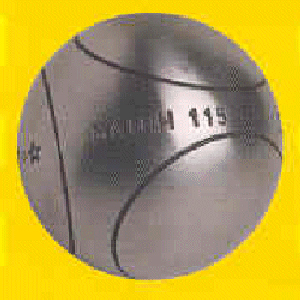
MATCH115ITVous étiez à Villefranche le samedi 24 janvier dernier à l’occasion du concours en triplettes organisé au boulodrome couvert. Vous jouez avec des OBUT 700 grammes. Vous êtes peut-être la personne que l’on recherche. Ce samedi en question, un échange de boule a en effet eu lieu entre une boule OBUT Match 115 et une OBUT 110 strie 1. Pensez à vérifier votre matériel et si vous constatez une anomalie, merci de nous contacter :

  • soit en laissant un commentaire en fin de page ;
  • soit en nous adressant un mail  à l’adresse suivante :
    cyrille.costes@gmail.com ;
  • soit en nous appelant au 06 21 06 80 65.

Finale départementale en doublettes à Villefranche : le site du foirail toujours en course

On sait que la Pétanque Villefranchoise, qui avait choisi le site du Foirail pour accueillir la finale départementale en doublettes le week-end des 30 et 31 mai, s’était opposée aux basketteurs utilisateurs de l’espace dans le cadre de leur manifestation annuelle. Tenace, le président Michel Guilhem n’a pas jeté l’éponge : « Les discussions et autres négociations sont encore en cours mais on devrait arriver à trouver un compromis ». Voilà qui serait une excellente nouvelle pour les pétanqueurs (seniors, féminines et jeunes) qualifiés pour cette finale départementale tant les terrains bitumés entourant le foirail de la Madeleine peuvent s’avérer très intéressants pour offrir un spectacle de qualité. Affaire à suivre.

Un nouvel éclairage pour le boulodrome couvert à Villefranche ?

Vendredi dernier, la Pétanque Villefranchoise avait convié élus, partenaires et autres sponsors à, participer à une rencontre informelle conclue par un repas convivial. Lors des discussions avec les élus, il fut notamment question du remplacement de l’éclairage actuel par un système offrant des conditions de jeu beaucoup plus avantageuses. Municipalité et société de pétanque seraient tombées d’accord pour un cofinancement de cet investissement. Les travaux pourraient intervenir dès cette année 2015 pour offrir aux utilisateurs un outil beaucoup plus confortable dès la prochaine saison hivernale.                                                                                                                                                                                                                     ,

2 629 connexions ce lundi… les Masters vous intéressent

Masters samedi à Rodez, Masters dimanche à Creissels… record (presque battu) de connexions lundi  sur le site www.petanque12.com. En ce début de semaine, vous avez été, en effet, 2 629 à vous connecter pour lire les résultats et autres commentaires liés à ces épreuves. Le record du 17 novembre dernier (2 895 connexions)   tient toujours la corde. Jusqu’à quand ? Quelque chose nous dit que le lancement des championnats dès cette fin de mois de février pourrait chasser le 17 novembre des tablettes statistiques. Dès le dimanche 1er mars, lendemain d’une journée où se disputeront le 1er qualificatif Ligue (tête-à-tête à Villeneuve) et le dernier qualificatif du Master doublettes à Saint-Affrique ? Peut-être. Mais là, c’est à vous de jouer. Comme dirait l’autre, la boule est dans votre  camp !

Masters doublettes de Creissels :
Claude et Julien Guilhem, le retour

Les Villefranchois ont signé un beau retour au premier plan en s’imposant ce dimanche en terre creisselloise. 

Vous devez être abonné pour visualiser ce contenu.
Connectez-vous en utilisant la boite de connexion en haut de la colone de droite ou souscrivez à l’une des formules d’abonnement si vous n’êtes pas encore membre.
Abonnez-vous

mercredi 30 septembre 2026